

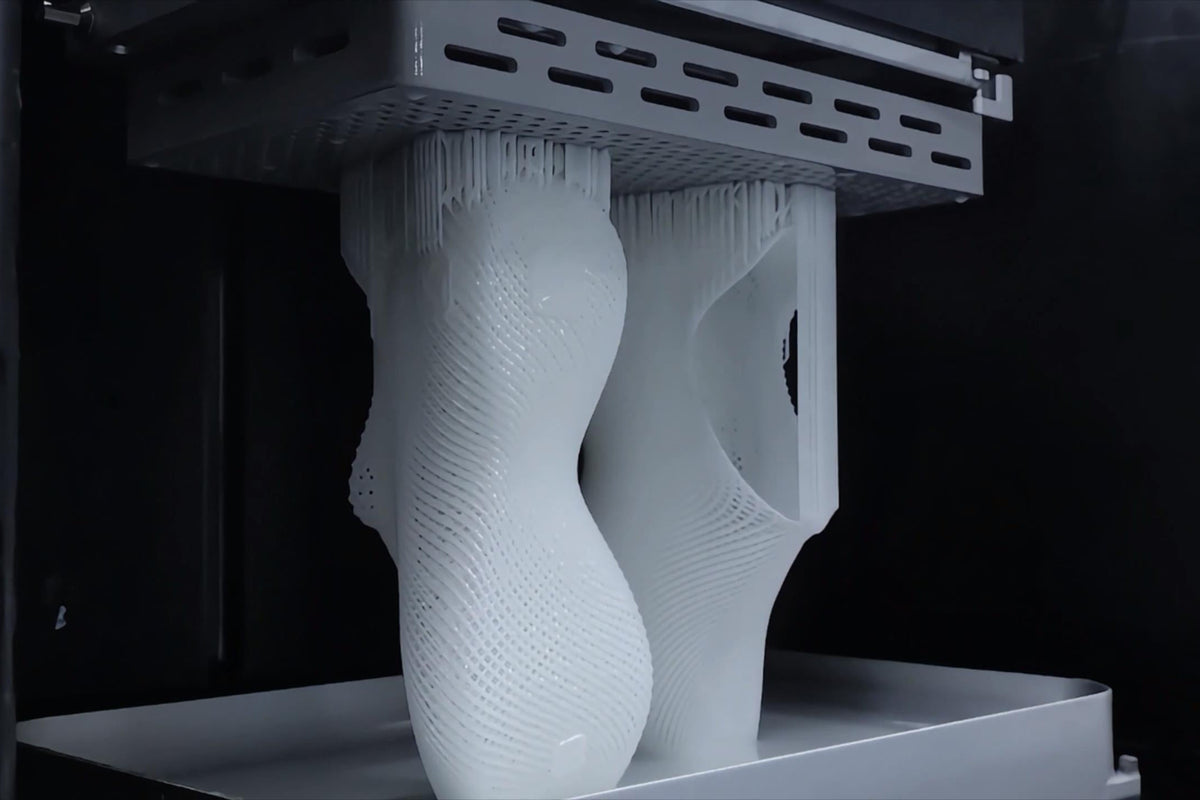
Standing in a modern factory today, you might expect the rhythmic clanging of heavy machinery or the hiss of steam from injection molding lines. Instead, a new sound is beginning to dominate: the subtle, high-frequency hum of light and liquid working in perfect synchronization. For decades, 3D printing was the "cool kid" of prototyping—relegated to the fringes of the factory floor, producing one-off models that were too slow and too fragile for the real world. But something has shifted.
According to recent data from Grand View Research, the global 3D printed shoes market was valued at $2.3 billion in 2025 and is projected to soar to over $8.8 billion by 2033. This exponential growth isn't coming from better hobbyist machines; it is being driven by industrial technologies that can finally match the speed and scale of traditional manufacturing. Leading this charge is a process known as HALS—Hindered Asynchronous Light Synthesis. By moving beyond the "layer-by-layer" limitation, HALS is turning the dream of a digital factory into a high-speed reality.
This article explores the mechanics of HALS, how it differs from established technologies like Carbon DLS, and why it has become the backbone of brands like ARKKY in their quest to redefine footwear for the 21st century.
Defining HALS: Beyond Traditional Photopolymerization
To understand HALS, we must first look at what it fixed. Traditional 3D printing—technically known as additive manufacturing—has long been plagued by the "Staircase Effect" and the "Peel Barrier." In standard SLA (Stereolithography) or DLP (Digital Light Processing), each layer is cured against a hard surface and then mechanically pulled away. This mechanical stress limits speed, requires excessive support structures, and creates weak points between layers.
HALS (Hindered Asynchronous Light Synthesis) belongs to the Vat Photopolymerization family, but it operates on a fundamentally different chemical and mechanical logic. It is not a process of building; it is a process of growth.
What is HALS 3D Printing?
HALS (Hindered Asynchronous Light Synthesis) is an ultra-high-speed 3D printing technology that utilizes a specialized chemical inhibition layer (the "Dead Zone") and AI-driven asynchronous mechanical control to produce isotropic, industrial-grade parts at speeds up to 100 times faster than traditional SLA.
Unlike its predecessors, HALS allows for 3D printed shoes and other complex geometries to be produced as monolithic, seamless entities. By eliminating the need to stop and peel for every layer, the printer can continuously "draw" an object out of a liquid vat, resulting in a smooth finish and mechanical properties that are identical in every direction (isotropy).
The Physics of the "Dead Zone": The Hindered Mechanism
The first half of the HALS acronym stands for "Hindered." This refers to a masterstroke of chemical engineering known as the Inhibition Layer or the Dead Zone.
In a standard resin printer, the liquid resin cures directly against the bottom of the tank. To prevent the part from getting stuck, the printer must pause, lift the build plate, wait for new resin to flow in, and lower it again. This "peel-and-wait" cycle accounts for nearly 90% of total print time.
HALS solves this by creating a microscopic layer of chemical inhibition (usually oxygen or a specialized chemical agent) at the bottom of the vat. This layer acts as a permanent liquid buffer—a "Dead Zone" where light passes through but resin cannot cure.
- Liquid Air Cushion: The curing process actually happens a few microns above the bottom window, suspended on a thin cushion of liquid resin.
- Non-Stop Flow: Because the part never actually touches the window, there is zero suction force. The build plate can move upward continuously without ever stopping to "peel."
- Isotropic Integrity: Because there are no discrete layers and no mechanical interruptions, the molecular chains cross-link more effectively, resulting in parts that are as strong as injection-molded plastics.
The Role of AI: Achieving Asynchronous Control
If the "Dead Zone" provides the physical possibility for speed, Asynchronous Control provides the intelligence to manage it. This is where AIHALS separates itself from earlier iterations of continuous printing.
Traditional high-speed printing is synchronous: the light intensity is fixed, and the mechanical movement follows a pre-set curve. HALS, however, uses an AI neural network to decouple these two elements.
Dynamic Light Field Optimization
As the build plate lifts, the volume of resin being cured changes constantly. A dense midsole base requires different energy than a delicate lattice structure upper. The HALS AI algorithm analyzes the cross-sectional area in real-time, adjusting the UV LED matrix intensity millisecond by millisecond.
Thermal Management and Fluid Dynamics
Rapid photopolymerization is an exothermic reaction—it generates heat. If not managed, this heat can warp the part or degrade the resin. The HALS system uses predictive modeling to anticipate heat accumulation based on the part's geometry. It then adjusts the lifting speed (the "asynchronous" part) to ensure that resin reflow is perfectly balanced with the curing rate, preventing internal stresses and ensuring sharp, accurate edges even at speeds exceeding 500mm/hr.
HALS vs. Carbon DLS vs. Traditional DLP: A Technical Comparison
While technologies like Carbon's DLS (Digital Light Synthesis) pioneered the concept of the oxygen-permeable window, HALS represents an evolution in material flexibility and AI integration.
| Feature | SLA (Stereolithography) | DLP (Standard) | Carbon DLS | HALS (AI-Driven) |
|---|---|---|---|---|
| Light Source | UV Laser (Point) | Projector (Area) | UV LED Matrix | AI Dynamic Light Field |
| Speed | 10-20 mm/hr | 20-50 mm/hr | 100+ mm/hr | 300-600+ mm/hr |
| Mechanism | Layer-by-Layer | Layer-by-Layer | Continuous (Oxygen) | Asynchronous Continuous |
| Isotropy | Low (Weak Z-axis) | Medium | High | Industrial-Grade (Full) |
| Material Base | Acrylic/Epoxy | Acrylic | Polyurethane (PU) | High-Elasticity TPU/Bio-Resin |
| Best For | Fragile Prototypes | Dental, Jewelry | Midsoles, Gaskets | Mass Production, Apparel |
The primary differentiator for HALS is its scalability. By optimizing the fluid dynamics via AI, HALS can handle much larger build volumes without the resin "starvation" issues that often plague other continuous processes when printing wide, solid parts.
Material Ecosystem: The Power of Polyurethane and Beyond
A technology is only as good as the materials it can process. HALS was developed alongside a massive library of over 5,000 formulations by PollyPolymer. These aren't just "3D printing resins"; they are engineered polymers designed to replace traditional rubbers and plastics.
High-Elasticity Polyurethane (TPU)
For brands like ARKKY, the "Holy Grail" is a material that offers the rebound of high-end foam with the durability of a solid rubber. HALS elastomers utilize a dual-cure mechanism. After the initial light-curing (which sets the shape), the parts undergo a thermal post-cure. This secondary reaction creates a dense, cross-linked network of polyurethane chains, providing superior tear resistance and long-term elasticity.
The Sustainability Shift: Bio-Based Resins
Sustainability is no longer an optional feature. HALS technology now supports bio-based resins containing up to 53% renewable content derived from plant sources. These materials are not only eco-friendly to produce but are also designed for circularity—they can be ground down and reprocessed at the end of their life cycle, unlike traditional EVA foams which often end up in landfills.
Case Study: How ARKKY Redefined Footwear with HALS
The most visible application of HALS technology today is on the feet of thousands of consumers. ARKKY has leveraged the speed and precision of HALS to move from traditional manufacturing to a Digital Inventory model.
Monolithic Design
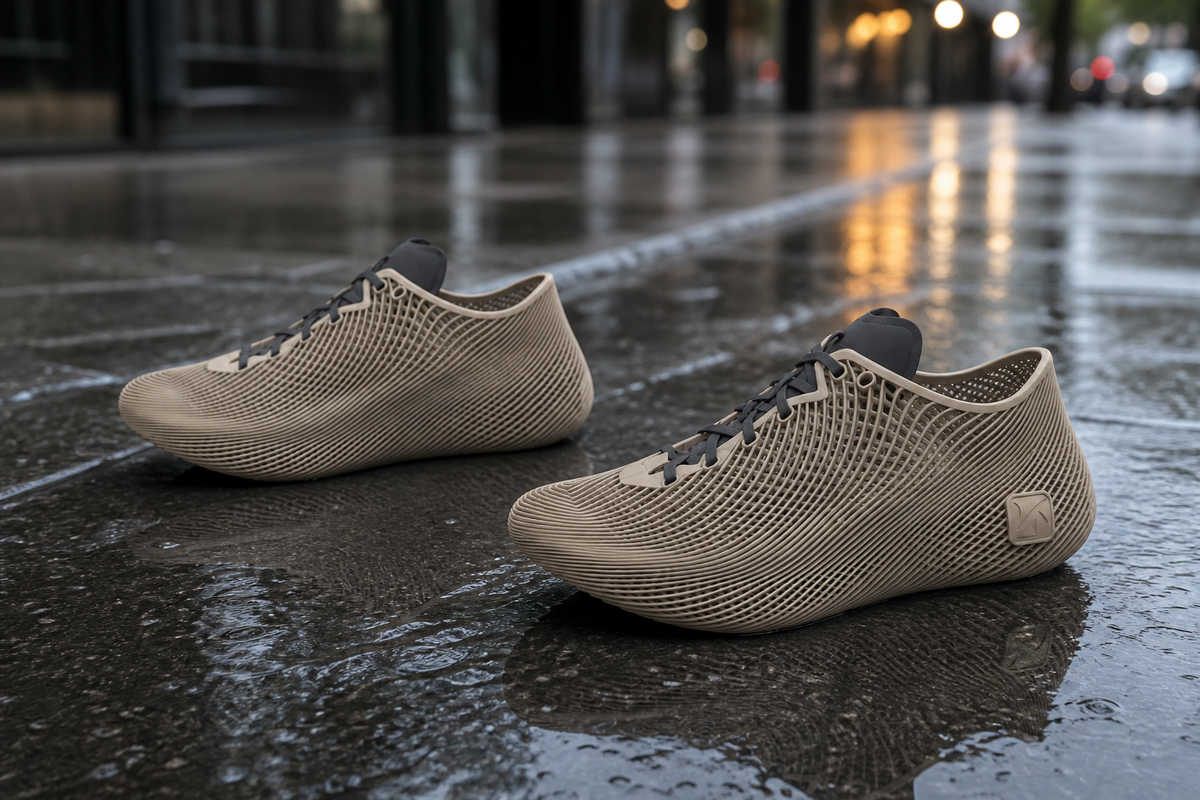
Traditional sneakers are made of dozens of parts glued together. This creates points of failure and limits breathability. With HALS, ARKKY can print a "Monolithic Shoe"—a single-piece construction where the upper, midsole, and outsole are one continuous structure. This is only possible because HALS can handle the complexity of varied lattice densities in a single print run.
Mass Production at Scale
One of the biggest criticisms of 3D printing was that it could never compete with injection molding for volume. HALS has shattered that ceiling. With a printing time of approximately 30 to 60 minutes per pair, a single HALS production cell can produce hundreds of units per day. This allows for Zero Inventory manufacturing, where shoes are printed as they are ordered, eliminating waste and reducing the carbon footprint of global shipping.

Shopping Guide: Choosing the Right 3D Printed Footwear
If you are looking to experience HALS technology first-hand, the choice comes down to your primary use case.
1. For Peak Performance: ARKKY AeroDash Series
The AeroDash represents the pinnacle of HALS engineering. Its lattice midsole is tuned for energy return, making it ideal for runners or those who spend 8+ hours a day on their feet.
- Why it wins: The HALS-printed lattice offers superior energy return and impact absorption compared to standard EVA foam.
- Best for: Running, long-shift workers, and high-impact sports.
2. For Daily Comfort: ARKKY CozLite Series
Utilizing the 53% bio-based resin technology, the CozLite series is the choice for the lifestyle-focused consumer.
- Why it wins: It offers the signature HALS breathability in a relaxed silhouette, perfect for recovery or casual wear.
- Best for: Daily wear, eco-conscious shoppers, and home/office comfort.
The Future: A Factory in Every City?
HALS is more than just a faster way to cure resin. It represents a fundamental shift in how we think about objects. When you can print industrial-quality parts at the speed of light, the need for massive offshore factories begins to vanish. We are moving toward a future where "Made in China" or "Made in USA" is replaced by "Made Down the Street."
As AI continues to refine the HALS process, the complexity of what we can grow will only increase. Today it's shoes; tomorrow it could be high-performance automotive parts, specialized medical implants, or even elements of our homes. The liquid revolution has only just begun.
Share:
Quick-Dry Shoes: Why Lattice Soles Beat Foam and Mesh