

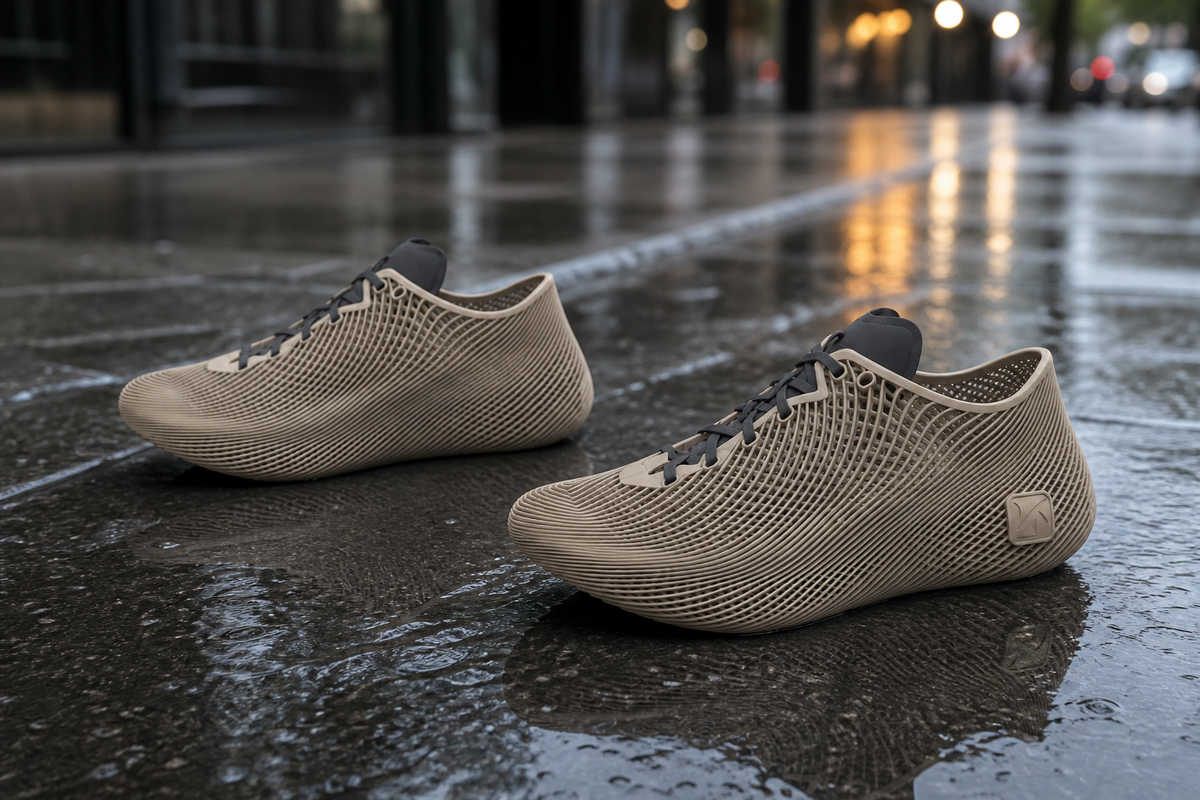
Most people notice it on the walk home. The rain eases, the pavement begins to steam, and everything you are carrying dries off within minutes — the jacket, the bag, the phone screen. Your shoes do not. Hours later the inside of the shoe is still cold and damp, and by evening there is a smell that no amount of airing out seems to fix.
I kept circling that gap while reading footwear research, because the numbers describe something most shoe copy never mentions. A 2025 study in the Journal of Industrial Textiles built a heated, sweating foot model to test breathability directly, then ran it inside leather boots for eight hours. Internal temperature stayed within a comfortable range the whole time. Moisture was the failure point: discomfort related to wetness began at around 240 minutes and worsened past the 300-minute mark, when in-shoe humidity reached 80% (Yalçın & Karavana, 2025). Not heat. Water.
A 2022 study in Applied Ergonomics approaches the same weak link from the other direction. Its authors found that conventional insole materials trap heat and moisture inside the shoe, and that a 3D-structured textile insole with open porosity improved the microclimate around the foot (Ning, Yick, Yu & Yip, 2022). A systematic review of 101 manuscripts in the Journal of Foot and Ankle Research reached a compatible conclusion from a wider angle: footwear comfort is shaped by design features and physiological factors together, not by cushioning alone (Journal of Foot and Ankle Research, 2021).
Across all three, the pattern is the same. What happens to water inside a shoe matters as much as what happens under your foot.
So this article asks one narrow question: why does an open, lattice-structured sole dry faster than the two constructions most shoes are built from — foam and mesh? To answer it, I work through the physics of drainage and evaporation, the peer-reviewed measurements of what actually happens inside footwear, the point where mesh genuinely helps and the point where it stops, and the way the same open geometry changes airflow and cushioning. Where a direct three-way drying comparison does not exist, I say so instead of inventing a number.
What you should be left with is a practical way to judge a wet-weather shoe on the parts that decide whether your feet are dry by the time you reach the office.

Why Wet Feet Stay Wet — The Physics Most Shoe Copy Skips
Water leaves a material only when three conditions line up at once: the water has a route to the surface, air can reach that surface, and the air can carry the vapour away. Every construction choice in a shoe either helps those three conditions or fights them.
Evaporation Needs a Path, an Opening and Moving Air
Think of a wet sponge on a counter. It dries because water migrates to the surface through open pores, air touches that surface, and vapour leaves. Seal the same sponge in a plastic bag and it stays wet for days. Nothing about the water changed; the route and the airflow did.
A shoe is a sponge you wear. The upper, the lining, the insole and the midsole each decide whether your sweat and any water that gets in can travel that same three-step path. Closed structures break the chain at step one.
Why Foam Holds Water So Well
Foam earns its place in a midsole by holding a shape under repeated load, and it does that with tightly packed cells. Many of those cells are closed or only partially connected, which is exactly what you want for cushioning and exactly what you do not want for moisture. Water that enters the structure has limited access to the surface and even less access to moving air, so it sits in place until it slowly diffuses out.
This is why a soaked foam midsole stays heavy and cold for hours. You are not waiting for the water to evaporate from a surface; you are waiting for it to migrate through a material designed to resist that migration.
Where Mesh Helps — and Where It Stops
Mesh is a genuinely open weave, and that is a real advantage. A mesh upper presents a large surface area to the air and gives vapour a fairly direct route out, which is why mesh dries far faster than a leather or coated upper.
The limit is orientation. A mesh upper is a wall, not a floor. Almost all of its open area faces sideways and upward, so water sitting in the footbed has to travel against gravity to reach it. And underneath the mesh there is usually foam doing the job described above. That combination — an open upper above a closed midsole — is why so many wet sneakers end up with a dry-looking outside and a still-damp interior hours later.
The lattice vs. mesh comparison on ARKKY's knowledge blog looks at how the same two structures handle heat; the water side follows the same logic, for the same reason.

What the Research Actually Measures
It is worth being precise about the evidence here, because the available studies measure moisture inside footwear rather than staging a drying race between three sole types. That distinction matters if you are deciding what to trust.
| Study | What it measured | What it found that bears on wet feet |
|---|---|---|
| Yalçın & Karavana, Journal of Industrial Textiles, 2025 | Breathability and thermal comfort, using a sweating and heated foot model inside leather boots over eight hours | No temperature discomfort, but moisture-related discomfort appeared near 240 minutes and worsened past 300 minutes, once internal humidity reached 80% |
| Ning, Yick, Yu & Yip, Applied Ergonomics, 2022 | A textile-fabricated insole with a 3D open structure versus conventional insole materials | Conventional insoles trap heat and moisture; the open, porous 3D structure improved foot skin temperature and humidity |
| Systematic review, Journal of Foot and Ankle Research, 2021 | 101 manuscripts covering definitions, measurement, design features and physiology | Footwear comfort is driven by design features and physiological factors together — cushioning alone does not determine how a shoe feels |
What These Findings Do and Do Not Prove
They establish that moisture, not temperature, is the variable that degrades comfort first, that an open internal structure measurably improves the foot's microclimate, and that structural design — not softness — is what moves the outcome.
They do not establish a specific drying time for a lattice sole against a foam sole. No published figure for that comparison came up in this review, so none is quoted here. The comparison further down is built from measured material behaviour plus the mechanics of drainage and evaporation, and it is labelled as such.
The One Number Worth Remembering
Roughly four hours. That is how long a well-sealed shoe took, in a controlled test, before wetness became a comfort problem — and the conditions in that test were far milder than a rainy commute. Shoes that hold water do not fail gradually over days. They fail inside a single afternoon.
How an Open Lattice Sole Handles Water
A lattice midsole replaces a solid block with a three-dimensional grid of interconnected struts and open cells. The cushioning comes from how that geometry compresses; the moisture behaviour comes from the fact that the cells are open all the way through.
Cells Instead of Sealed Walls
In a foam block, water has to diffuse through material. In an open lattice, water is in contact with air on every strut surface, including the surfaces facing downward. That single geometric difference changes both how fast water can leave and how much of it the structure can hold.
Drainage Happens Before Saturation
Water behaves predictably under gravity. Give it a downward path and it takes it. In an open sole, water entering from above continues down through the cells and exits at the bottom face rather than accumulating in the material. By the time the shoe is heavy enough for you to notice, much of the water that entered has already left.

The Same Open Cells That Drain Also Ventilate
Drainage and ventilation are the same property seen from two directions. The open volume that lets water fall through is also the volume through which air moves with every step, because the sole flexes and the cell volume changes. ARKKY treats airflow as a core property of the lattice across its site; the mechanism itself is straightforward — flexing compresses the cells, and the cells refill with outside air when the load comes off. A fuller explanation of that effect is set out in ARKKY's article on 360° breathability in 3D footwear, and the printing side is described on its technology page.
What an Open Sole Does Not Do
An open lattice is not waterproof, and it is not trying to be. Water that comes in over the collar still gets in. Extremely fine grit and dust can lodge between struts more easily than they lodge in a smooth foam surface. And in cold weather, an open structure moves more air than a sealed one, which cuts both ways. If your priority is standing in slush for two hours, a sealed boot remains the right tool. If your priority is being dry again 30 minutes after the rain stops, the open structure is the one that gets you there.
Lattice, Foam and Mesh Side by Side
This is the comparison the whole article builds toward. Read it as a description of how each structure behaves with water, not as manufacturer specifications.

| Behaviour | Open lattice sole | Foam midsole | Mesh upper over foam |
|---|---|---|---|
| Route water takes | Straight through open cells | Into closed or semi-closed cells, where it stays | Through the weave, then blocked by the foam beneath |
| Drainage | Immediate, assisted by gravity | Minimal; water leaves mainly by slow diffusion | Slow; the weave holds droplets by surface tension |
| Air exchange | Continuous through the full sole volume | Very low; foam is a barrier | Good across the upper, near zero below it |
| Direction of drying | Downward and outward | Upward only, against gravity | Sideways and upward |
| Behaviour when saturated | Structure itself holds little water | Can stay heavy and cold for hours | Upper dries first; the footbed stays wet longest |
| Cushioning source | Cell geometry | Foam formulation, subject to compression set | Depends entirely on the midsole below |
| Typical wear-out mode | Strut fatigue in the highest-stress zones | Foam flattens and loses rebound | Weave abrades and pills |
Reading the Table in Real Conditions
The rows that matter most for a rainy commute are drainage and direction of drying, because those decide what happens in the first thirty minutes. The rows that matter most for daily wear are the last two, because they decide how long the shoe stays worth wearing.
The honest summary: mesh is the best of the three at shedding water from the upper, foam is the worst at releasing water from the midsole, and an open lattice is the only one of the three whose primary structure is designed to let water pass straight through it.
If your interest is specifically the foot-sweat problem rather than rain, ARKKY's guide to breathable shoes for sweaty feet covers that case in more detail.
The Rest of the Wet-Weather Kit
Shoes are the largest variable in this system, but they are not the only one. Three other parts decide whether a good sole actually delivers dry feet.
Socks Set the Ceiling
A cotton sock absorbs water and holds it against your skin, which is the worst combination available: it keeps the moisture in the exact place you want it gone, and it stays wet after the shoe has dried. A wool or technical synthetic blend moves moisture away from the skin and releases it into the shoe's air volume, where the structure can deal with it. No sole geometry can compensate for a saturated cotton sock.
Insoles Are Half the Microclimate
The Applied Ergonomics finding is worth restating here, because insoles are the layer people replace last and think about least. Conventional insole materials trap heat and moisture directly under the foot; an open, porous structure improves temperature and humidity at the skin. If you are rebuilding a shoe for wet weather, the insole is not a detail.
Water That Comes In From Above
Most wet feet on a rainy day are not caused by water passing through the sole. They are caused by water coming in over the collar — through the tongue gap, the ankle opening, or a saturated lace channel. That is a fit and coverage question, not a midsole question, and no drainage feature solves it.
A Drying Routine That Actually Works
After a soaking, the goal is air movement rather than heat. Remove the insoles, loosen the laces, open the collar, and leave the shoes somewhere with real airflow, ideally with the open structure exposed so air can pass through the cells rather than just over them. Skip the machine dryer: heat degrades adhesives and can distort printed structures. ARKKY's guidance on why air drying suits lattice shoes covers the specifics.

How to Judge a Quick-Dry Shoe Before You Buy
Photos will not tell you how a shoe handles water. The construction will.
Start With the Sole, Not the Upper
Turn the shoe over. On a mesh-and-foam shoe, the underside is a solid wall — water that gets in has nowhere to go. On an open structure, you can see through the midsole, which is the whole point.
What Drainage Looks Like
Look for cells that pass all the way through the sole rather than surface dimples or decorative cut-outs. Press the midsole with a thumb: if it compresses and springs back without feeling spongy, the geometry is doing structural work rather than the material alone.
What Cushioning Should Still Do
An open structure is only useful if it is comfortable. Check that the lattice is thicker or denser in the heel and forefoot, where load is highest, and more open in the midfoot. Uniform lattices feel clever and wear unevenly.
A Note on Stack Height and Water
A taller stack gives water more distance to travel before it reaches your foot, but it also gives you more material to drain. In practice, a moderate stack with genuinely open cells outperforms a tall stack with narrow channels.
Then the Upper
Prioritise a woven or knit upper with large open areas over a coated or sealed one, unless you specifically need wind and splash protection. A sealed upper is a decision to keep water in as well as out.
Then the Interior
Check the insole separately from the shoe. Removable insoles that can dry on their own are a meaningful advantage, and a lining that stays smooth when wet resists the friction that leads to blisters.
What to Ignore
Ignore "waterproof" badges on shoes you intend to wear in warm rain — you will be trading a small amount of water ingress for a much longer drying time. Ignore cushioning numbers without a stated test method. And ignore any claim about drying speed that does not name what it was measured against.
Shoes Built Around an Open Midsole
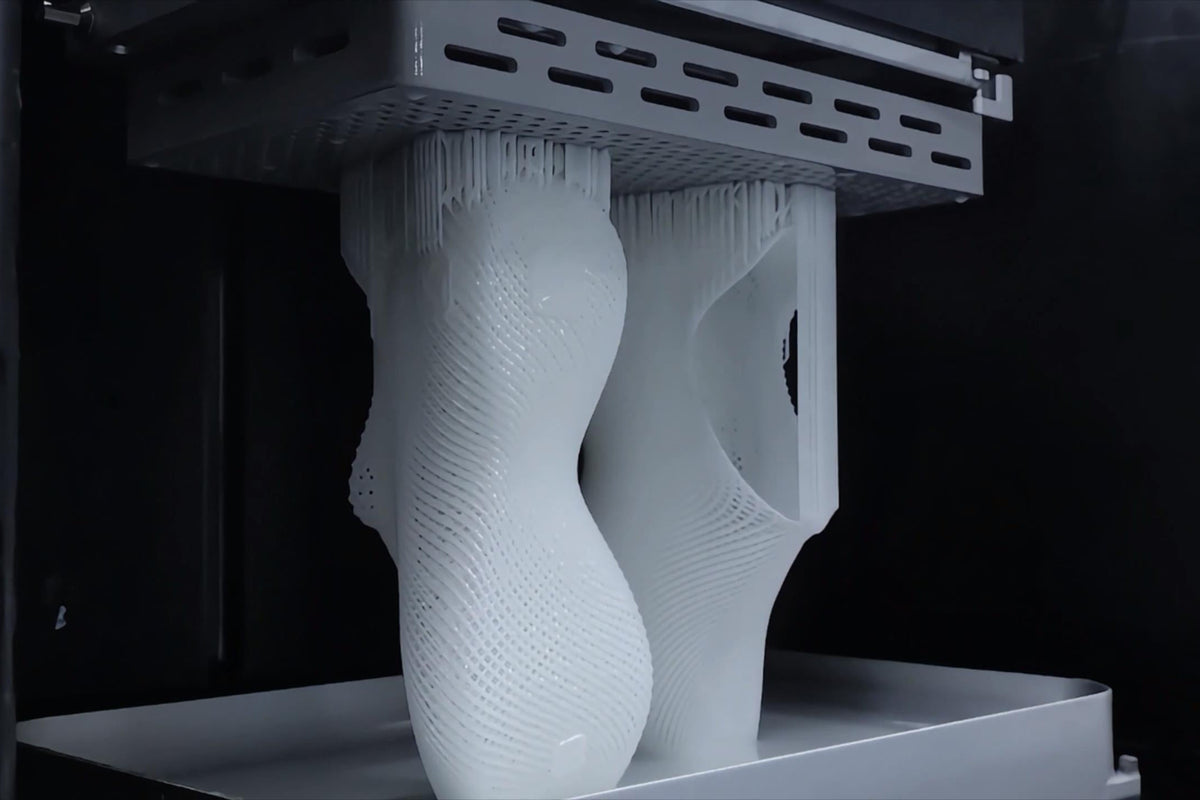
If you want to see the structure described above in an actual product rather than in the abstract, ARKKY builds its footwear line around printed lattice midsoles. Three options cover most wet-weather use cases, and the reasons below are about construction rather than styling.
ARKKY AeroDash
A sneaker built on a printed lattice midsole and positioned in ARKKY's sport-oriented range. It suits someone who wants one pair that can take a wet commute without turning into a sponge, because the drainage comes from the sole structure rather than from a coating. Check the AeroDash product page for current sizing, materials and specifications.
ARKKY AeroLace
A lace-up sneaker that keeps the same open-midsole approach in a more everyday shape. Pick it if you want the drainage behaviour of an open midsole in a shoe you would wear outside a training context. Details and current options are on the AeroLace product page.
ARKKY CozLite 101 and CozLite 305
Slipper-style models, and the least enclosed construction in the range. For genuinely wet, warm conditions — pool decks, beach walks, humid summer travel — that matters, because there is very little material left to stay wet in the first place. See CozLite 101 and CozLite 305, and browse the full 3D printed footwear range or the Daily Ease collection if you would rather compare across models.
A practical note before ordering: printed footwear fits differently from conventionally built shoes, and sizing varies by model. The size chart is worth reading first, and the FAQ answers the common shipping and return questions.
A Test You Can Run With the Shoes You Already Own
You do not need a laboratory to see which of your current shoes behaves like a foam block and which behaves like a drain.
The Pour Test
Hold the shoe over a sink and pour a cup of water into the footbed. Watch where it goes. If it pools and sits, the structure is holding it. If it exits through the bottom within a few seconds, you are looking at a drainage-first design.
The Squeeze Test
Press the midsole firmly and release. Listen and feel for air moving: a light rush of air out of the cells means the structure is ventilating when it flexes. A dead, solid response means the midsole will not move air at all.
The Weight Test
Weigh the shoe dry, soak it fully, blot the outside, and weigh it again immediately. The difference tells you how much water the structure itself retains, separately from the water sitting in the footbed. A large gain that does not fall after 30 minutes of airflow is the clearest possible sign that you are wearing a foam block.
Questions People Actually Ask
Do quick-dry shoes keep water out?
No, and most are not designed to. Quick-dry construction assumes water will get in — over the collar, through the upper, or underfoot — and focuses on getting it back out quickly. If keeping water out is your priority, you want a sealed, waterproof boot and you accept a longer drying time when water gets in anyway.
Are lattice soles as durable as foam?
That depends on the material and cell geometry rather than the concept. Molded lattice structures move load through struts rather than through a compressible block, which avoids the compression set that flattens foam over time. The countervailing risk is strut fatigue in the highest-stress zones, so the density distribution in the sole matters more than the pattern itself. ARKKY publishes its own durability position in its material and stability article; treat manufacturer claims as claims, and check the warranty terms before buying.
Can you dry lattice shoes in a machine dryer?
Not advised. Heat softens adhesives, and printed structures can distort when they are tumbled while warm and damp. Air movement is faster and safer: insoles out, collar open, and a fan if you have one.
How long does a lattice shoe take to dry?
There is no published controlled figure for lattice versus foam drying time, and any specific number you see quoted without a method should be treated with caution. What can be said from the mechanics is directional: a structure with open cells and downward drainage begins shedding water immediately, while a foam structure holds water until it diffuses out. The practical difference shows up within the first hour, not over days.
What This Means for Your Wet-Weather Kit
The rain itself is rarely the problem. The problem is what your shoes do with the water after the rain stops — and that is decided by structure, not by softness, price or branding.
The Short Version
Moisture, not temperature, is what makes a wet shoe uncomfortable first. Foam holds water because it is built to be closed. Mesh helps at the upper but stops at the footbed. An open lattice sole drains downward, ventilates as it flexes, and holds very little water in its own structure. Socks and insoles decide how much of that advantage you actually feel.
How This Article Was Researched
Three peer-reviewed sources anchor the moisture claims, linked inline: a 2025 breathability study in the Journal of Industrial Textiles, a 2022 Applied Ergonomics study on 3D-structured insoles, and a 2021 systematic review in the Journal of Foot and Ankle Research. Product-specific statements are attributed to ARKKY's own published pages and are marked as manufacturer claims where they are claims. Comparative behaviour between sole structures is derived from material mechanics and is labelled as such, because no controlled three-way drying study was located. Where a number did not exist, none was supplied.
If you want the same reasoning applied to heat rather than water, the breathability article on mesh versus lattice structures continues the thread.
يشارك:
Youth Development: Should Kids Wear 3D Shoes?
ما هي الطباعة ثلاثية الأبعاد بتقنية HALS؟ — فك شفرة ثورة الإنتاج الضخم في بلمرة الراتنج الضوئي الأصلي