


Somewhere around the third hour of a summer day, most of us stop thinking about the heat and start thinking about our shoes. The foot is doing something remarkable that we rarely credit it for: it is sweating on purpose, in one of the densest sweat territories on the human body. Physiology reviews put eccrine gland density on the palms and soles at roughly 250 to 550 glands per square centimeter — the highest of any body region — and these glands answer to emotional as well as thermal signals (Baker, Temperature, 2019). That sweat exists to evaporate and carry heat away; when a shoe blocks evaporation, the foot's cooling system runs without an outlet. Research on shoe microclimate shows the consequences are measurable: in a 2024 study, shoes with closed upper structures produced higher in-shoe temperature and humidity than open, more air-permeable uppers, and participants' lower-leg temperatures followed the same pattern (Journal of Thermal Biology, 2024). There is even a documented chain from that trapped heat to injury: heat drives moisture, and moisture increases friction force inside the shoe — the mechanism behind the foot blisters that sideline so many runners and hikers (Friction blisters of the feet, National Library of Medicine).
This article grew out of a simple observation: the shoe industry sells "breathability" almost entirely as a fabric property of the upper — more mesh, more holes, more "airflow zones" printed on the side of the box. But the foot does not sit on the upper. It sits on an insole, above a foam midsole, wrapped in a sock, inside a chamber whose lower half is usually built from materials that cannot pass air at all. The result is that many "breathable" shoes are really only ventilated on top. This piece explains what breathability means physically, why feet get hot in the first place, where conventional mesh construction stops working, and how open-cell 3D-printed lattice design addresses the parts of the shoe that mesh never touched — with heat escaping through the structure and cooler air drawn in as you move. Along the way you will find a comparison of construction approaches, honest guidance on what published evidence does and does not show, and a testing routine you can run in a store without any equipment.
What "breathable" actually means
Breathability is the ability of a shoe to keep the air next to your skin from turning into a warm, humid pocket. In textile testing, engineers measure this as air permeability — the volume of air that passes through a given area of material under a set pressure difference (the basis of standard test methods such as ASTM D737). But a shoe is not a fabric swatch. A shoe is a chamber, and chamber comfort depends on three separate physical processes:
- Permeability — air passing through a material. This is what mesh marketing talks about, and it is genuinely useful: air through the upper carries heat and water vapor out.
- Convection — air moving through spaces. When open channels exist, warm air rises out while cooler, denser air is drawn in below or behind it, and every step can act like a small bellows, pushing air through the shoe.
- Drainage and evaporation — what happens to liquid. Sweat that stays trapped against the skin cannot evaporate efficiently; sweat that can drain away or evaporate from an open surface cools the foot and stops moisture from accumulating.
A shoe can be strong on the first process and still feel stifling if the second and third never happen. That distinction — surface holes versus a through-and-through air path — is the entire difference between most conventional "breathable" shoes and a genuinely open construction.
Why an airy upper alone does not keep feet cool
Think about where the heat actually lives. The warmest, sweatiest parts of the foot — the sole and the sides of the heel — are in contact with the insole and the lining, not with the mesh on the outside of the upper. Air that flows over the top of your foot is useful, but it never reaches the surfaces doing most of the sweating. If the lower chamber of the shoe is sealed, the top half of the shoe being ventilated is like opening a window in the attic while the ground floor has no doors.
The reason feet run hot: physiology in numbers
It helps to be precise about the problem before comparing solutions. The foot is not a small version of the rest of the body; it is one of the most eccrine-gland-dense regions we have. Two implications follow. First, the soles sweat even when the rest of the body is dry — and because these glands respond to emotional as well as thermal stimulation, nervous days make it worse (Baker, 2019). Second, the sheer volume adds up: podiatric fact sheets commonly cite roughly 250,000 sweat glands in a pair of feet producing as much as half a pint of moisture per day (APMA Foot Facts).
That moisture is not the enemy by itself. Sweat is the body's primary evaporative cooling system: as water changes from liquid to vapor on the skin, it pulls heat out of the tissue, which is why sweat evaporation plays a critical role in human thermoregulation — and why people in encapsulating gear overheat when their sweat cannot evaporate (Baker, 2019). The problem is only ever that the shoe prevents evaporation. A foot sealed inside a low-permeability chamber is a foot whose cooling system has been switched off, no matter how light the fabric feels on top.
Three sources of heat inside a shoe
| Heat source | Where it comes from | What a shoe can do about it |
|---|---|---|
| Metabolic heat | Working muscles and the foot's own circulation generate heat continuously | Let it convect away instead of trapping it against the skin |
| Friction | Movement between foot, sock, insole, and upper converts motion into heat | Lower friction materials and less moisture; dry surfaces slide more predictably |
| External warmth | Hot pavement conducts and radiates into the sole; sun heats the upper | Separate the foot from the ground with an air layer and limit solid contact paths |
A shoe that addresses only the third source — say, by adding mesh to the upper while leaving a thick foam slab under the foot — is solving the least important part of the problem for most people. The largest heat loads are metabolic and frictional, and both are managed by airflow and evaporation, which brings us to the microclimate research. Multiple studies have now measured what users have always suspected: the environment inside a shoe differs measurably between constructions, with less permeable shoes showing higher temperature and humidity, and wearers able to perceive the difference (Applied Ergonomics, 2019). The 2024 upper-structure study went further and connected that microclimate to the rest of the leg — open structures lowered both in-shoe conditions and shank temperature (Journal of Thermal Biology, 2024).
What mesh and knit can and cannot do
Modern mesh and engineered knit uppers deserve credit: they are the most air-permeable conventional shoe materials we have, and a well-made knit shoe is a genuine improvement over the leather-and-lining shoes of a generation ago. Air permeability measurements exist precisely because these fabrics pass measurable volumes of air, and that matters for the top of the foot. But a mesh upper is still a fabric shell wrapped around a mostly sealed chamber, and three structural realities limit how much it can do.
The lower chamber is closed. Below the foot sits a sockliner, then a midsole — almost always a closed-cell foam such as EVA — then a rubber outsole. Closed-cell foam is, by definition, a material whose cells do not connect: it does not breathe, and it does not drain. The mesh may be gossamer, but the sole under your foot is a vapor barrier. Heat generated at the sole has no vertical escape route; it can only spread sideways under the foot.
The path through the upper is interrupted. Look closely at any mesh shoe: the mesh is stitched and glued to a frame, covered by overlays, logos, heel counters, and lining layers, and it sits over a sock that absorbs sweat and holds it against the skin. Air that enters through a mesh panel may travel only a few millimeters before meeting a solid layer. The effective "window" of a mesh shoe is far smaller than the area of mesh looks.
Moisture is stored, not removed. Woven and knitted fibers absorb and hold water. Sweat soaks into the sock and the lining, where it stops evaporating efficiently and starts doing the thing moisture does best in a shoe: raising friction. National Library of Medicine reviews of foot blisters describe exactly this chain — heat creates moisture, moisture increases friction force inside the shoe, and friction produces blisters (NLM review). This is why blister advice always begins with keeping feet dry: it is not cosmetic advice, it is tribology.
None of this is an argument that mesh shoes are bad. They are the right answer to a question nobody asked: how do you ventilate the top of a shoe whose bottom cannot breathe? The answer mesh gives is "as best we can from above."
How an open-cell lattice changes the airflow path

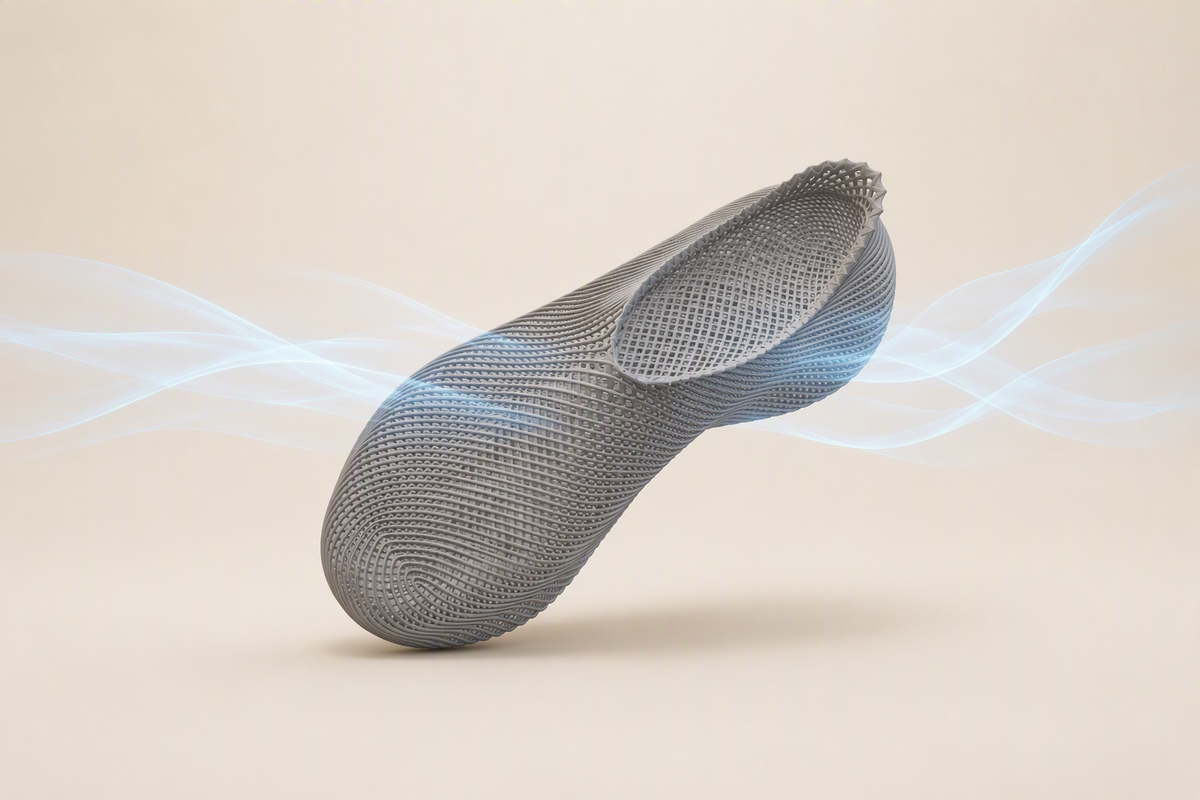
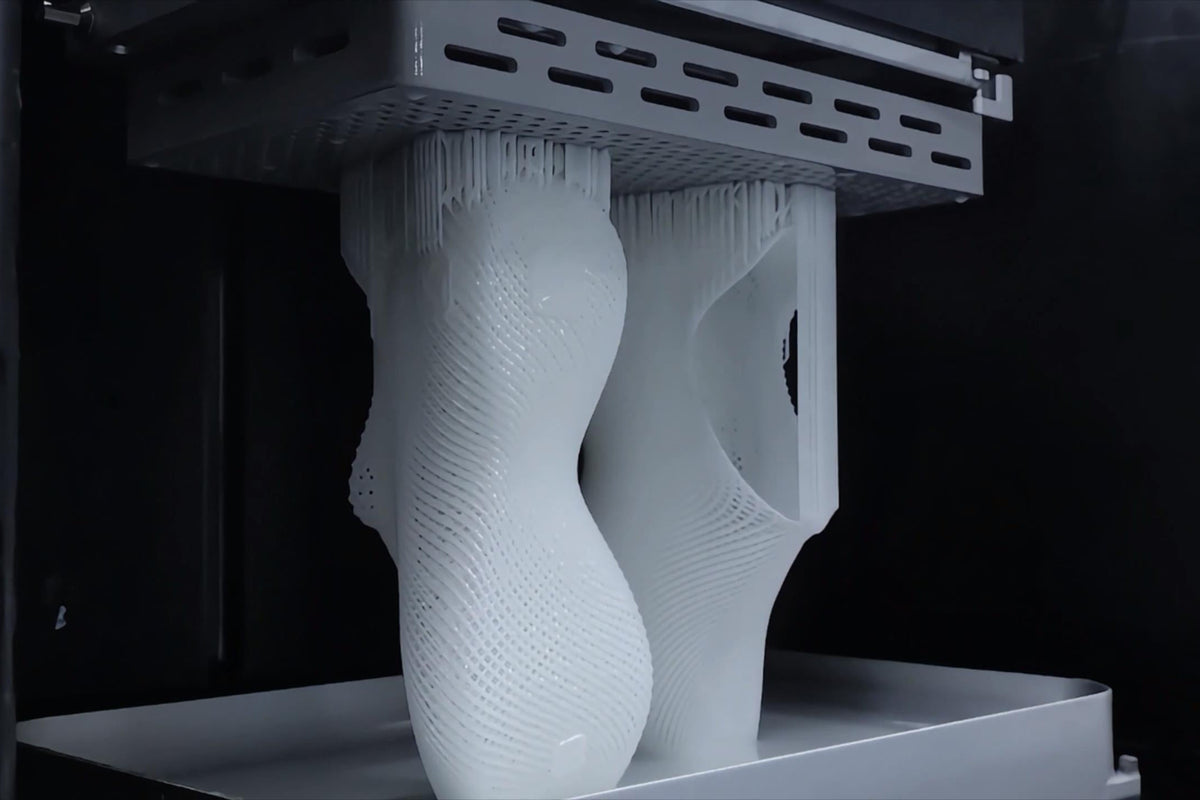
A 3D-printed lattice midsole is a different category of object from a foam slab or a fabric shell. It is not a solid with holes punched in it; it is a continuous network of struts enclosing interconnected voids — technically, an open-cell structure that runs through the entire thickness of the shoe. That single property changes all three processes from the previous section at once.
Permeability through, not just on top. Because the void network is continuous from the top of the midsole to the bottom edge and across the sides, air has a path through the full thickness of the shoe, not just through the upper. Where a foam shoe has a vapor barrier under the foot, a lattice shoe has an air layer under the foot. The surfaces doing the most sweating — the sole and the sides of the heel — are now in contact with open structure instead of sealed foam.
Convection in both directions. Warm air is less dense than cool air, so it rises. In an open structure, heat produced at the sole can rise through the lattice and leave the shoe at the top, while cooler, denser air is drawn in around the edges to replace it. During walking or running the effect compounds: each foot strike compresses the lattice slightly and pushes air out, and each recovery phase lets the structure spring back and draw fresh air in — a gentle pumping action that works with no moving parts. These are the same physics of natural and forced convection that building designers use to ventilate rooms; the lattice simply brings that logic to a few millimeters under your foot.
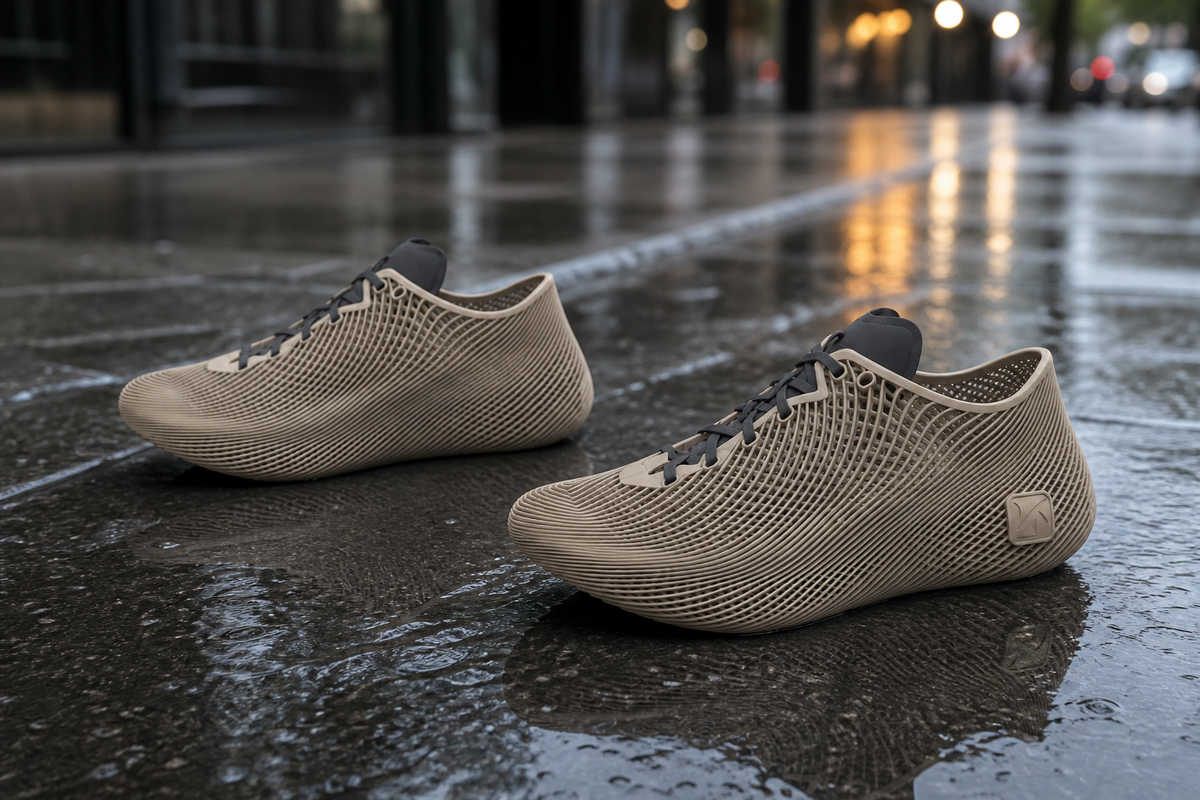
Drainage instead of absorption. The lattice material in most printed shoes is a thermoplastic polyurethane (TPU), and TPU absorbs only negligible amounts of water compared with textile fibers. A drop of sweat on a TPU strut has nowhere to soak in: it beads, runs down the strut, and — if the shoe has open drainage paths at the sole — exits the shoe entirely. Water that cannot be absorbed also cannot stay trapped against the skin, and a shoe that drains is a shoe that dries quickly after rain, puddles, or a rinse in the sink. This is the material-science counterpart to the drainage channels you see engineered into many printed soles.
What the evidence does — and does not — show
Being precise here matters. Published studies confirm that the air permeability of the shoe modifies its microclimate: open structures measurably reduce in-shoe temperature and humidity compared with closed ones, and users can feel the difference (Journal of Thermal Biology, 2024; Applied Ergonomics, 2019). What the literature does not yet contain is a head-to-head, peer-reviewed comparison of a full printed-lattice shoe against a premium mesh shoe under identical conditions with a large sample. So the honest claim is structural rather than statistical: an open-cell lattice removes the sealed lower chamber that every foam-and-mesh shoe has, and it replaces the moisture-holding lining with a material that cannot absorb water. Both changes are physics; neither requires a marketing department. Treat specific "degrees cooler" numbers from any brand with suspicion until you see the test protocol.
The difference is visible

You can see the openness with your own eyes. Hold a printed-lattice shoe up to the light and look through the midsole: if you can see light through the sidewalls and through the sole, air can move through them. Do the same with a foam shoe and the midsole is opaque — because it is a sealed block. That single visual test, light passing through the thickness of the shoe, is the most honest two-second summary of the difference this article is about.
Breathability construction comparison

Put side by side, the four mainstream ways of making a shoe "breathe" look like this:
| Construction | Where air actually flows | What happens to sweat | Heat path | Water handling | Main weakness |
|---|---|---|---|---|---|
| Woven mesh upper + foam midsole | Through the upper only | Absorbed by sock and lining, held against skin | Blocked below by the closed-cell foam slab | Soaks in and stays; dries slowly | Sealed lower chamber under a ventilated top |
| Engineered knit upper | Through knit areas, interrupted by overlays and lining | Wicked into fibers, then evaporates only at the surface | Same foam barrier underfoot | Retained in fabric until it evaporates | Moisture storage; structural layers limit open area |
| Perforated leather or synthetic | Through punched holes only | Trapped on the sockliner unless holes line up | Same foam barrier | Holes help little if the lining soaks | Tiny effective open area; lining and foam still seal |
| Open-cell 3D-printed lattice (full shoe) | Through the whole thickness — upper, midsole, sidewalls | Nothing to absorb: TPU drains instead of holding | Convects upward and out; air layer underfoot | Beads and drains; quick-dry after rinsing | Newer category; quality depends on the density map and drainage design |
Two honest notes on the table. First, "full lattice" shoes still vary a great deal: a printed shoe with very dense cells and a solid sockliner breathes less than one with genuinely open zones and open drainage paths — check the construction, not the label. Second, for most people the practical difference is not measured in laboratory temperature drops; it is measured in whether your feet feel dry at hour six. The research supports the mechanism; your own feet are the final experiment.
Who notices the difference most

Breathability is not a universal craving — different feet and different days care about it very differently. In rough order of priority:
People with sweaty feet, hot feet, or hyperhidrosis
If your feet sweat heavily — and remember the baseline is already roughly half a pint per pair per day, with some people producing far more (APMA Foot Facts) — then moisture management is not a comfort preference, it is the whole game. For this group the two structural facts that matter most are the ones mesh cannot deliver: an air layer instead of a foam vapor barrier under the foot, and a lining material that cannot absorb and hold sweat. Conventional advice to "wear moisture-wicking socks and change shoes often" still applies, but it is a workaround for a chamber that cannot dry itself.
Summer commuters and city walkers
Hot pavement is a real contributor to foot heat, and it has nothing to do with the upper. A thick foam sole conducts warmth from the ground up into the foot on every step; an open lattice with drainage paths keeps a layer of air between foot and pavement and lets ground heat dissipate instead of accumulating. People who walk a lot in warm weather tend to notice this difference faster than runners do, because they spend hours on sun-heated sidewalks rather than minutes on shaded trails.
Travelers and sockless wearers
Airport days and beach-to-cafe transitions punish shoes that hold moisture. A fabric shoe worn sockless is a sponge by lunchtime; a TPU lattice shoe has nothing to absorb moisture into, drains after a rinse, and dries in a fraction of the time. This is also the group that answers "can you wear them without socks?" most enthusiastically — and the honest answer depends on the individual shoe's interior finish, not on the word "printed."
Hot-weather runners and hikers
For runners, the strongest case for open construction is the documented link between microclimate and leg temperature — open structures lowered in-shoe conditions and shank temperature in the 2024 study (Journal of Thermal Biology, 2024). For hikers, the drainage side matters as much as the airflow: a shoe that sheds stream water instead of absorbing it keeps the day comfortable long after a crossing. The trade-off to respect is structural: very open lattice zones give less cushioning surface than dense foam, so the shoe's density map — where it is open and where it is firm — decides whether it suits easy miles or hard training.
Judging a shoe's breathability with your own hands
No lab required. Four checks take two minutes and will tell you more than any spec sheet:
The light test. Hold the shoe up to a window or lamp. Can you see light through the midsole and sidewalls? Through the upper? A foam midsole is always opaque — it is a sealed block. Openness you can see is openness air can use.
The breath test. Cup your hand over the top of the shoe and blow hard into the side. Feel air moving through the upper, then do the same at the sole. Air that passes through the bottom of the shoe means the chamber is not sealed; air that only ruffles the mesh means the lower half is a dead end. If you blow into a mesh shoe and feel nothing through the sole, you have just measured the vapor barrier.
The drainage test. Pour a small cup of water through the shoe over a sink. A moisture-holding shoe darkens, soaks, and drips slowly; an open draining shoe sheds most of the water within seconds and stops dripping quickly. This is the single most predictive test for hot-weather and rainy-day comfort.
The wear test. Walk for ten minutes on a warm day, then take the shoe off and touch the sockliner and the inside of the upper. Dry or merely damp means the construction is moving moisture; soaked means it is storing it. Repeat the same test with your current shoes and you will finally have a side-by-side comparison of what each construction actually does.
What to look for when you shop
Shopping for airflow is shopping for structure, so the recommendations below are organized by what your feet actually need. Every pick should pass the four tests above before you commit.
An open-lattice printed shoe, if your complaint is heat and moisture all day long. Who it is for: sweaty or hot feet, summer commuters, travelers, and anyone tired of shoes that stay damp. Why: this is the only mainstream construction that removes the closed-cell foam barrier under the foot, replaces moisture-absorbing lining with TPU that drains, and lets air move through the full thickness of the shoe. Arkky's AeroDash line is built this way — the brand describes the design as breathable from every angle with a fully open lattice — and its AeroDash starts around $199 on arkky.com, with AeroBB as the more street-oriented variant (Arkky). Reasons to hesitate: printed shoes are a new category, so check the density map and drainage paths on the specific model rather than trusting the word "lattice," and confirm the interior finish is smooth enough for sockless wear if that matters to you. If you want to compare current models yourself, browse the current line of breathable sneakers and run the four tests on anything you shortlist.
A lab-tested mesh or knit shoe, if you are a runner who wants proven upper ventilation with traditional structure. Who it is for: runners who are satisfied with socks-and-mesh comfort and want the largest possible catalog of proven models. Why: the mesh-and-knit category has decades of refinement, and independent reviewers now publish actual breathability testing of uppers rather than trusting marketing claims — a genuinely useful resource when comparing models (RunRepeat breathability catalog). Reasons to hesitate: remember the table above — the upper is ventilated while the midsole remains a sealed foam block, so on very hot days the sole of the foot still sits on a vapor barrier; choose the shoe for the top of your foot and know what the bottom will feel like.
A quick-dry, open-drainage shoe for water and travel use. Who it is for: hikers, beachgoers, and anyone who regularly walks through water. Why: drainage beats absorption for every wet activity, and a shoe that sheds water instead of holding it prevents the soggy-sock misery that causes most hot-weather foot complaints. Reasons to hesitate: drainage channels add openings that can admit grit, so consider where you will wear them — open soles that excel on pavement and streams are less ideal on dusty trails where debris finds its way in.
A moisture-management layered system, if you have diagnosed hyperhidrosis or chronic foot odor. Who it is for: anyone whose sweating is heavy enough to interfere with daily life. Why: no shoe replaces medical care. The right layering — moisture-wicking socks, an open or draining shoe, spare socks for long days, and daily drying — is the practical standard, but heavy sweating that disrupts your life is worth a podiatrist's opinion rather than a shoe review. Reason to hesitate: none, really — this is the one recommendation that is about you, not about the product.
A closing caveat for every option: "breathable" is a marketing word until you verify the structure. Light through the sole, air through the bottom, water that drains — those four tests will tell you whether a shoe earns the word, regardless of the price tag or the logo.
Common questions about airflow and 3D-printed shoes
Are 3D-printed shoes more breathable than mesh shoes?
Structurally, yes for the lower half of the shoe: mesh ventilates the upper while a foam midsole seals the bottom, whereas an open-cell lattice lets air pass through the full thickness and drains water instead of absorbing it. Whether a specific printed shoe actually feels cooler depends on its density map, drainage design, and interior finish — verify with the light and breath tests.
Do 3D-printed shoes make your feet sweat more?
There is no mechanism for that. Sweating is driven by your physiology, not by the sole material. What a shoe controls is what happens to the sweat after it appears: an open lattice lets it evaporate and drain, while a sealed chamber holds it against the skin. The relevant question is not whether you sweat in them, but whether you stay dry.
Can you wear 3D-printed shoes without socks?
You can, but it depends on the shoe's interior finish rather than on the fact of printing. Open-lattice shoes have no moisture-absorbing lining, which removes the usual reason socks are needed, but check that the internal surface is smooth at the heel and toe before committing to sockless days.
Do breathable shoes prevent blisters?
They address the moisture half of the blister equation. Blisters form when heat-driven moisture increases friction between skin and shoe (NLM review); a shoe that drains moisture and dries quickly removes that amplifier. Fit, sock choice, and how your foot moves still matter — drainage is a risk reduction, not a guarantee.
How do you clean a 3D-printed shoe?
The same property that makes them drain makes them easy to maintain: with no fabric to soak, most printed shoes can be rinsed under water, brushed lightly, and dried in a fraction of the time a mesh shoe needs. Always follow the manufacturer's care guidance — print settings and coatings vary between brands.
The takeaway
Hot feet are not a mystery and not a badge of toughness — they are the predictable result of a sealed chamber around one of the most sweat-dense surfaces on the human body. The conventional answer, mesh, ventilates the part of the shoe that needs it least while leaving the vapor barrier that causes the problem. Open-cell 3D printing is the first mainstream construction that removes that barrier: air moves through the thickness of the shoe, heat convects upward and out, and moisture drains instead of soaking in. The science of shoe microclimates says construction measurably changes the environment your foot lives in, and your own feet will confirm it faster than any study. Next time a shoe claims to breathe, skip the label and hold it up to the light. If you cannot see through the sole, the air cannot either.
This article is for general information and is not medical advice. If heavy foot sweating affects your daily life, consult a podiatrist or physician.
Share:
Lateral Stability in 3D Footwear: Solving the Wobble Effect
Drying Tips: Why Air Drying is Best for Lattice 3D Printed Shoes