

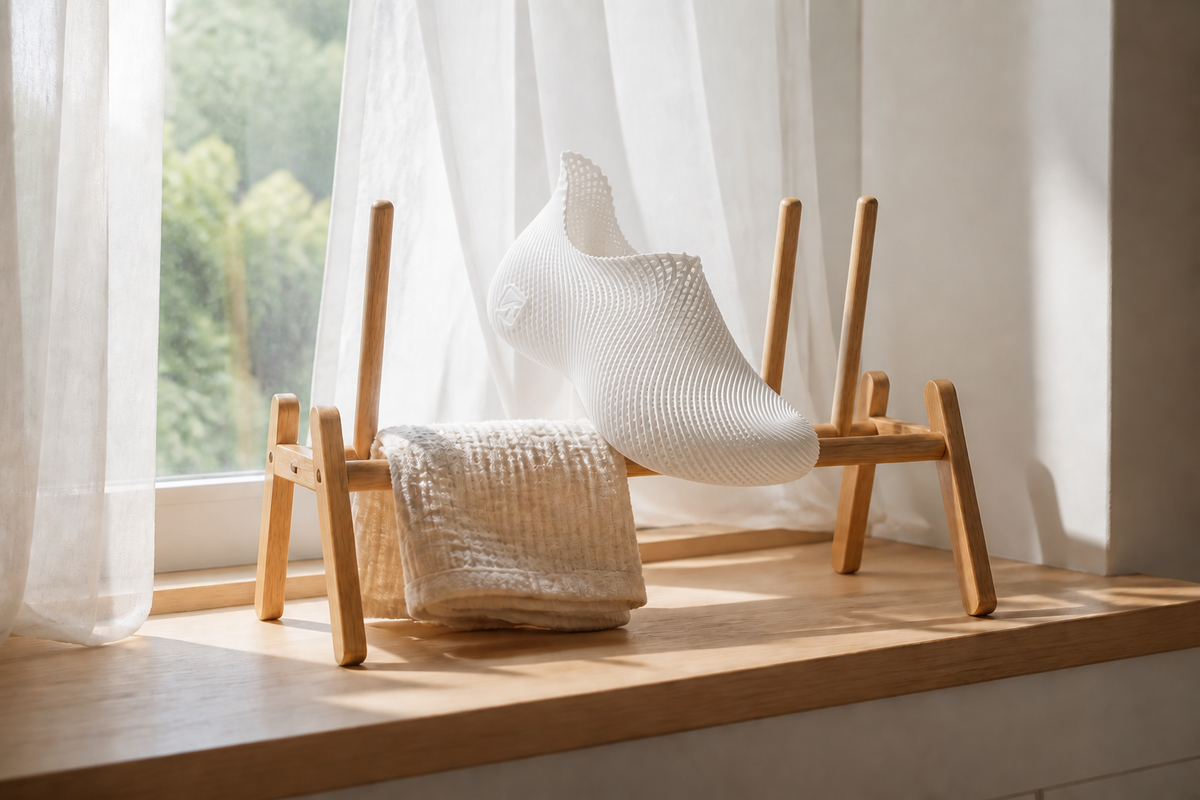

Every runner knows the feeling: the pair you rinsed last night is still damp at 6 a.m., and the dryer is right there. It takes about thirty seconds to decide — and the shoe industry has been quietly writing against that decision for years. Nike's guide to drying shoes is blunt about it: dryer heat can shrink a shoe and damage the glue holding it together, which is why their recommended methods are newspaper and a fan. Marathon Handbook's drying guide, written by a senior running editor with a master's in exercise science, goes further: the high heat of a clothes dryer can deform midsole foam and melt adhesives, and wet shoes that sit around degrade faster and start to smell. Even Allbirds, whose care page is otherwise machine-wash friendly, ends its instructions the same way — shake out the water, set aside to air dry, avoid machine drying.
This article is about the drying advice you rarely see, because it concerns a material system most care guides never touch: the 3D-printed lattice shoe. I work for ARKKY, which makes one, so let me be transparent about that from the start. What follows is the reasoning behind our drying guidance — why heat warnings exist, why a printed lattice shoe obeys them for different reasons than a glued foam shoe, and exactly how to dry one without giving up a whole day.
What the heat warnings are actually about
The standard advice not to bake your sneakers comes from two failure modes that live inside conventional shoes.
The first is glue. Most athletic shoes are assemblies: a midsole bonded to an upper, an outsole bonded to the midsole, held together by adhesives that soften when they get hot. That is why Nike and Marathon Handbook both mention melted or damaged glue as the reason to stay away from dryers and ovens. When the adhesive goes, the shoe does not fail all at once — it delaminates slowly, the sole peeling at the toe after a few more runs.
The second is foam. The EVA and PEBA compounds used in midsoles are gas-filled foams, and their rebound comes from the integrity of millions of tiny cells. High heat collapses or deforms those cells, and a collapsed cell does not recover. This is permanent, structural damage: the shoe may look fine and feel dead. Marathon Handbook describes exactly this — dryers that are too hot deform the cushioning material and damage the foam cells of the midsole.
Both warnings are correct, and both matter less for a shoe that contains neither glue nor foam. A one-piece 3D-printed lattice shoe has no adhesive layer to soften and no gas-filled cells to collapse. So if you own one, why should the air-drying advice still apply? Because the material itself — thermoplastic polyurethane — has its own relationship with heat, and because a well-designed lattice has no need for it in the first place.
Why a printed lattice shoe is a different drying problem

Thermoplastic means heat changes it
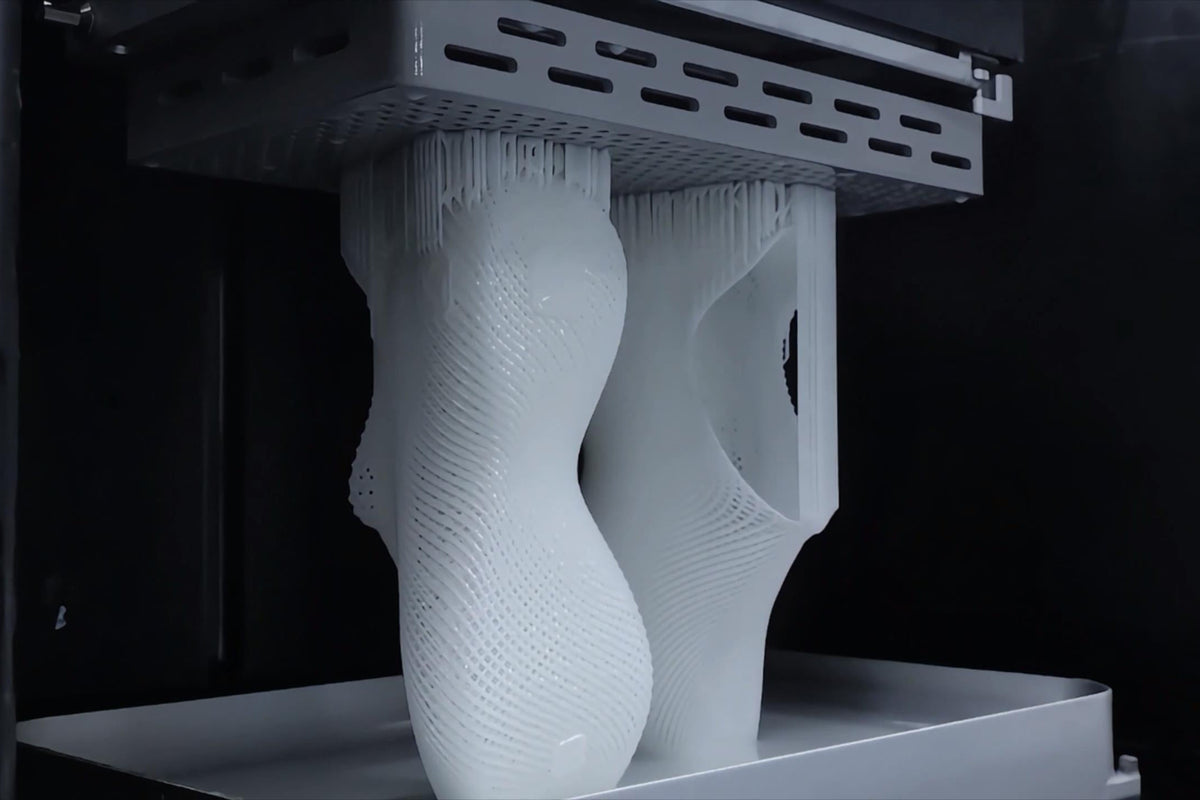
TPU is called a thermoplastic for a reason: heat softens it, and in its softened state it can be shaped — that property is exactly how printed shoes are made, layer by layer. What that means in reverse is that sustained heat after manufacturing can let the structure relax into a shape you did not intend, especially if the shoe is sitting under load or pressure at the time. A one-time hot dryer cycle is unlikely to destroy a well-printed shoe; ARKKY's own engineering writing on TPU notes that the material's structural segments do not begin to break down until temperatures pass 150 °C — far beyond what a household dryer produces, and more than double the roughly 60 °C that sun-heated ground can reach on a hot day. But "won't break" is a low bar. Heat accelerates aging in every polymer, and in colored printed shoes it also works against a surface finish that is applied after printing — ARKKY's product guidance asks owners to avoid scratching the sprayed coating on colored pairs, and heat is no friend to that finish either.
The honest framing is this: with a foam shoe, heat can cause sudden, visible damage. With a printed TPU shoe, heat causes slow, invisible wear — a gradual loss of that crisp return-to-shape that makes the lattice feel the way it does. Air drying protects the thing the shoe is made of.
Structure that dries from the inside out
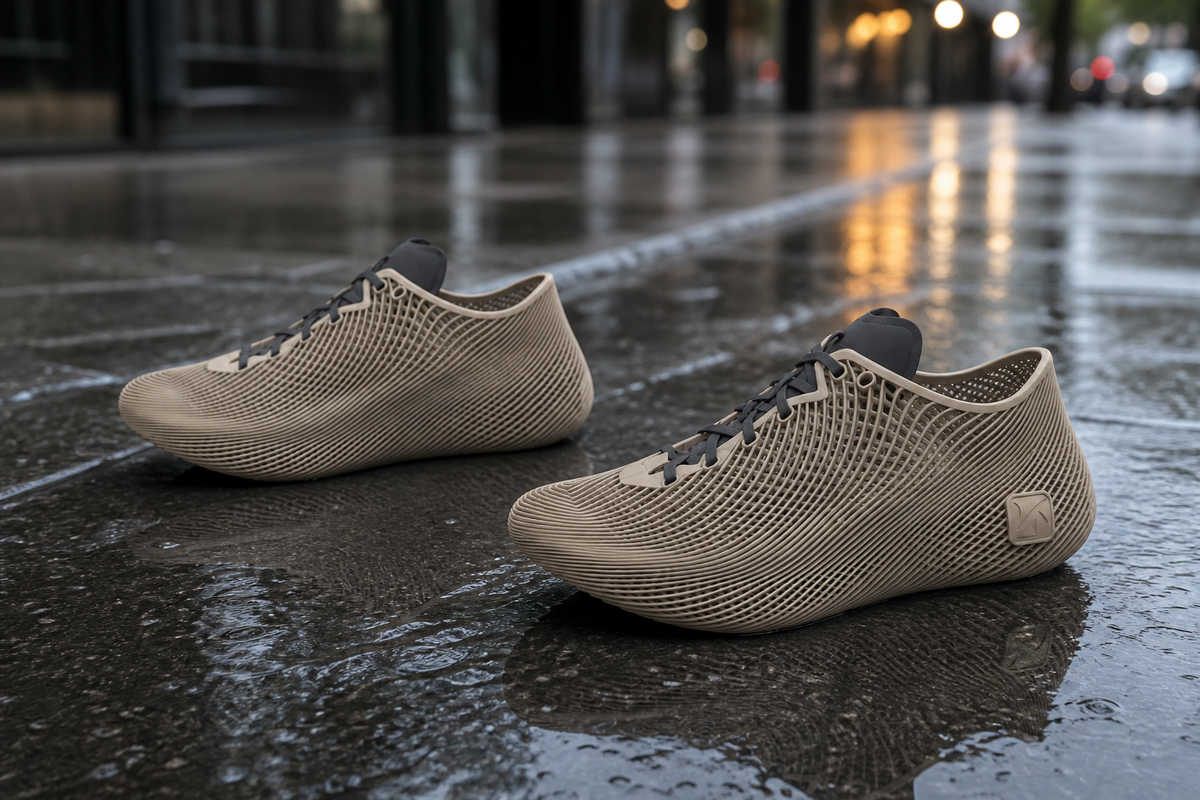
The second half of the argument is the part people find counterintuitive: a lattice shoe does not actually need help drying. Water does not soak into TPU the way it soaks into fabric or foam; it sits on the surface and drains away. ARKKY's AeroDash, for example, is printed with drainage channels described on the product page as shedding water instantly — the sole is designed in CAD to move water out rather than hold it. What little moisture remains sits as droplets on the open cells, where moving air reaches every surface at once, from the sole to the inside of the upper. There is no absorbent lining holding water against the shell, and no sealed foam slab keeping the bottom of the shoe damp for twelve hours. Given airflow, evaporation does the rest — which is why the shoe's own marketing line is dry feet by engineering rather than dry feet by heat.

Air drying versus the shortcuts in between
Not all shortcuts are equal, and it helps to see them side by side. The table below separates what each method does well from what it risks — for a conventional shoe and for a printed lattice shoe.

| Method | What it does well | What it risks (conventional shoe) | What it risks (printed lattice) | Verdict for lattice shoes |
|---|---|---|---|---|
| Plain air, ventilated room | Zero risk, zero energy | Slow for absorbent shoes | Fast — open structure evaporates quickly | The default |
| Fan-assisted air | Fast, still zero heat | Works well for most shoes | Ideal — airflow passes through the cells | Best speed/risk balance |
| Newspaper / towel stuffing | Wicks moisture from inside | Ink transfer, only surface absorption | Unnecessary — nothing to wick from | Skip |
| Low-heat shoe dryer | Convenient, gentle airflow | Fine if temperature stays low | Low heat is acceptable, but pointless vs. air | Optional, not needed |
| Clothes dryer | Fastest | Shrinkage, glue melt, foam damage | No glue/foam to destroy, but pointless tumbling and needless heat | Never |
| Hairdryer (high) | Feels fast | Can soften adhesives; fire risk | Concentrated heat on polymer and coating | Never |
| Radiator / space heater | Feels fast | Local overheating, material stress | Same local-heat problem on a smaller object | Never |
| Direct sun (long exposure) | Free, UV light helps kill bacteria | Can fade and age materials; hot asphalt worse | UV and heat age TPU and colored coating over time | Brief sun OK, shade better |
One honest caveat on the middle row. Some runners use low-heat shoe dryers daily and love them; Marathon Handbook's own guide recommends one. If you already own a dryer that only adds gentle airflow and modest warmth, it will not harm a printed shoe. The argument of this article is not that heat is radioactive — it is that a lattice shoe dries quickly enough on its own that you gain nothing from the extra temperature, and you give up a little polymer health every time you use it.
The air-drying routine that works in real life
There is a version of this routine for every situation, and none of it takes more than a minute of your time.
After a rinse or a rainy run
Shake the shoe firmly a few times to throw off the bulk water. The drainage channels do the rest, so do not wring or twist the shoe — a printed structure is tough, but there is no need to stress it. Set it upright on a rack or a towel in a room with moving air: by a window, under a ceiling fan, or in front of a floor fan. Colored pairs should sit out of direct, strong sun for long stretches to protect the sprayed finish. In most conditions a rinsed AeroDash is dry in a fraction of the time a soaked fabric trainer needs.
When you need it faster, without heat
Put the shoe in front of a fan and, if you are truly in a hurry, rotate it once halfway through so both sides get direct airflow. Because the structure is open end to end, a fan moves air through the interior as well as over the surface — the same 360-degree airflow design that keeps the shoe cool on hot days is what dries it on a rack. There is no need to stuff it with newspaper; there is no absorbent interior to dry out.
When odor shows up anyway
A shoe that never fully dries becomes a place where bacteria multiply — that is where the smell comes from, and it is the real reason drying matters for hygiene rather than comfort. If a pair has already developed an odor, rinse it thoroughly, dry it completely with airflow, and let sunlight do its work for a short time: ultraviolet light is documented to kill bacteria effectively (a 2020 PLOS ONE study, cited in Marathon Handbook's guide, is one reference for this). If the smell persists after a full rinse-and-dry cycle, that is worth flagging to the brand you bought from — with a single-material, washable design it should not.
What to do if a shoe already met real heat
Say the dryer ran, or the shoe spent an afternoon on a hot car floor. What now? First, check for visible distortion — a sole that no longer sits flat, an upper that looks relaxed or wavy where it used to be crisp. Second, check the fit on foot: if the geometry has settled into a new shape, you will feel it immediately as a loss of support rather than read it on a spec sheet. Third, do not try to "fix" it by reheating and reshaping — that is exactly the process that caused the problem, and it will make things worse. If a colored pair shows dulling or stress in the coating after strong heat, that is cosmetic, and ARKKY notes that the rebound performance of the material itself is not reduced by normal wear. If the shoe has genuinely distorted, the practical answer is to replace it and change the drying habit — this is one of the few care mistakes that shortens a printed shoe's life.
Choosing footwear that dries itself
The care advice above only matters if the shoe is worth caring for, which brings us to the recommendation half of this article. If you are tired of the weekly ritual of drying, deodorizing, and replacing foam trainers, a printed lattice shoe is worth a serious look — not because it is exotic, but because it removes the entire class of problems this article describes.
The reasons are concrete. A one-piece, glue-free construction means the single most common heat failure — melted adhesive — is structurally impossible; ARKKY describes the AeroDash as fused without glue, so there are no joints to dry out, crack, or soften (lifespan write-up). The drainage-lattice sole sheds water instead of soaking it up, so a rinse in the sink is a complete wash cycle and air drying finishes the job quickly (breathability comparison). And because the whole shoe is one material, it dries evenly — no "dry upper, still-damp midsole" pockets where mildew quietly sets up. If you care about the engineering behind the material, ARKKY's own writing on TPU stability and the bellows airflow of the open-cell structure explains both in detail (TPU stability, 360° airflow).
When a printed shoe is not the answer
Be equally clear about the limits. If you want a shoe you can throw in the washing machine without thinking, or if you need a technical trail boot with a deep lugged outsole, a printed lifestyle shoe is not built for that — buy the right tool. And if you simply prefer the look and range of conventional sneakers, this article makes no case against them; it only argues that when you do buy printed, the care is genuinely simpler. For owners and prospective owners who want to see the full current range of washable 3D-printed shoes, the ARKKY collection is where the specs and the care guidance live together.
Questions people ask about drying lattice shoes
Can I use a hairdryer on a cool setting?
A cool setting is mostly just airflow, so it will not damage the shoe — but it is also no faster than a fan, because the shoe dries through moving air rather than heat. Save the hairdryer for your hair.
Can a printed shoe be damaged in a hot car?
Sustained heat is the slow enemy of TPU, and a sealed car in summer is one of the few places that gets genuinely hot. Avoid leaving any shoe — printed or otherwise — in a hot car for hours after a rinse. One afternoon is unlikely to ruin a pair; a habit of it will age the material.
How long does a lattice shoe take to air dry completely?
It depends on how wet it is and how much air moves across it. A rinsed shoe in front of a fan is typically dry far faster than a fabric trainer; the brand's product claims describe drainage channels that shed water instantly, and the open structure means there is no absorbent material left to hold moisture. In humid, still air, give it longer and add a fan.
Do printed shoes need shoe trees or stuffing to keep their shape while drying?
No. A printed lattice holds its geometry through the structure itself — that is the point of printing it. Unlike leather or knit uppers, there is no material that sags and needs propping. Dry it upright on a rack or towel and it will hold its shape.
Will the color on colored printed shoes fade if I air dry them near a window?
Long, direct sun can age any colored coating, and ARKKY's colored pairs use a post-spray finish that is worth protecting. Near a window with indirect light is fine; hours of full sun is unnecessary and should be avoided.
The reason it matters
The drying habits we learn are built around materials most shoes used to be made of: absorbent fabric, adhesive, foam. A 3D-printed lattice shoe is a different material system, and it deserves care logic that matches its construction rather than borrowed from the foam era. Heat was a reasonable shortcut when shoes were wet sponges with glue inside; it is a needless risk when the shoe is an open structure that drains itself and dries through air. Air drying is not the slow, inconvenient option for a lattice shoe — it is the fast one. The routine takes a minute, the physics does the work, and the shoe keeps the elasticity it was printed to have. That is the whole argument: less heat, less work, and a shoe that stays the shoe you bought for longer.
Sources and further reading
- Nike, "The 2 Best Ways to Dry Your Shoes Without Damaging Them" — product-care guide (updated 2021).
- Marathon Handbook, "How to Dry Running Shoes Fast Without Wrecking Them" — expert guide by Amber Sayer, MS (updated 2026); cites Rezaie et al., PLOS ONE (2020) on ultraviolet light and bacteria.
- Allbirds, "Wash & Care" — brand care instructions.
- ARKKY knowledge hub: "Do 3D-Printed Shoes Last Longer?", "Lattice vs Mesh: Sneaker Breathability Comparison", "Beyond Plastic: TPU Durability & Stability in High-Performance Footwear", "360° Breathability: The Science of Airflow in 3D Footwear" — manufacturer engineering posts cited in this article.
- ARKKY AeroDash product page — manufacturer specifications and care claims (drainage lattice, one-piece glueless construction, post-spray color finish).
Share:
360° Breathability: The Science of Airflow in 3D Footwear
Youth Development: Should Kids Wear 3D Shoes?