

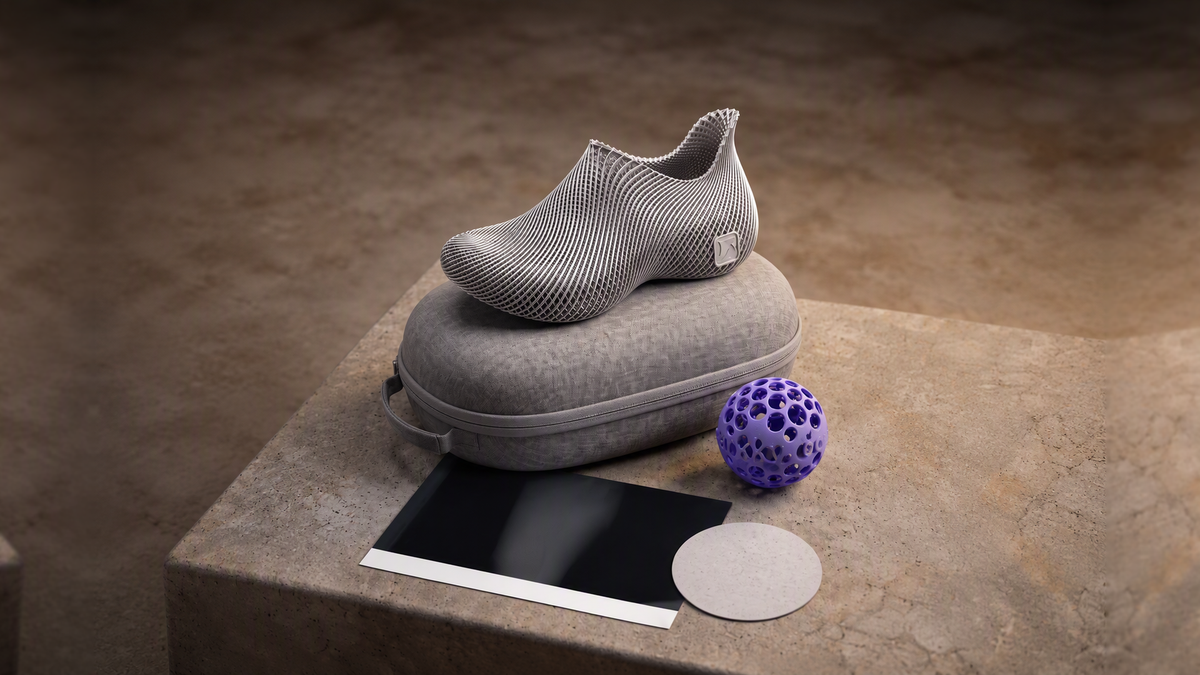
For most of the last decade, printed footwear behaved like a concept car. It appeared, it was admired, and then it disappeared from the shelf. Forbes put the pattern plainly in 2023: Adidas, Nike, New Balance, Dior, Reebok and Fendi had all launched 3D-printed limited editions, and "nearly all have failed to develop a lasting bond with the technology." The same piece notes that more than 20 billion pairs of shoes are made every year, that almost all will end up in landfill, and that an estimated one in five pairs is thrown away unworn (Forbes, 2023).
The reason was not design ambition. It was production. When adidas announced Futurecraft 4D in 2017 and called it its first mass-produced printed shoe, the plan was to make at least 5,000 pairs that year. A decade of reporting since then has been consistent about why that scale was hard: as Fast Company recorded at the time, the printers "were still prototyping tools, not a means of production," and Carbon's co-founder described the state of the art as slow and unscalable. Under Armour's printed shoe that year totalled 96 pairs (Fast Company, 2017).
That is the problem we set out to solve, and this article is about how we approached it. It covers why the custom-printing era could not scale, what the three genuine printing routes actually are, what an everyday shoe demands that a showpiece does not, and how to check which process made a pair you are looking at.

The Short Answer
Why Did Printed Footwear Stay Limited for So Long?
Because printing was treated as a way to make something special rather than a way to make something ordinary. The first wave used printing for form — sculptural pieces and runway shoes — and the second wave used it for fit, offering individual custom pairs built from a foot scan. Both are legitimate uses. Neither produces a shoe that a person can buy in a size, at a price, on a Tuesday, and replace when it wears out.
What Everyday Wear Actually Demands
- A size you can pick. Custom fit is a service; a size run is a product.
- A price a normal buyer will pay. Machine time still dominates cost, so the process has to be fast enough that printing time is not the whole bill.
- Comfort on an ordinary foot. Support where the foot loads, softness where it does not.
- Breathability that survives a summer commute, not just a runway walk.
- Durability measured in months of daily use, not in presentation photos.
- Predictable replacement. A person who likes a shoe wants to buy it again next year.
The Custom Era and What It Got Wrong
Fit Was Solved and Nothing Else Was
The custom model is attractive on paper: scan the foot, generate the geometry, print a pair that matches. Companies built real businesses around it, and several of them are gone. Sols, which raised more than $11 million for 3D-printed insoles, quietly shut down production; Feetz, which raised $1.3 million and ran pop-up scanning with a national retailer, moved and then faded; others simply went quiet.
The failure was not the idea. It was the arithmetic. A scanned, printed, made-to-order pair carries a scan, a design pass, a print run and a shipping cycle, and none of those costs disappear when the customer is one person instead of ten thousand. What you get is an excellent shoe for one foot and no way to sell it to the next person who walks in.
The Difference Between a Service and a Product
| Custom-printed era | Everyday printed line | |
|---|---|---|
| How you buy it | Book a scan, wait, receive | Choose a size and order |
| Who it fits | The person who was scanned | Anyone in the size run |
| What drives cost | Design and machine time per pair | Machine time per pair, amortised over a line |
| What happens when it wears out | Return for another scan | Buy the same shoe again |
| What the brand must own | A service operation | A repeatable product |
| What it proves | Printing can be precise | Printing can be ordinary |
Both columns use the same technology. Only one of them ends with a shoe you can replace.
The Three Printing Routes Behind Genuine Printed Footwear
There is a lot of loose language around printed shoes, so it is worth being precise about the processes. Three routes account for essentially all footwear that is genuinely additively manufactured.
Material Extrusion: FDM and FFF
Fused deposition modelling builds a part by pushing melted thermoplastic filament through a heated nozzle and laying it down in paths, layer on layer. It is the most accessible printing method in the world, and it is used in footwear — including at the desk-sized end, where designers and small studios print soft TPU uppers and soles. Its advantages are material choice, low equipment cost and easy iteration. Its constraints are speed, resolution and the fact that the bond between layers is a mechanical one, which is why the layer direction matters in a way it does not with a single continuous cure. Stratasys, which developed the process, describes it simply as extruding melted filament through a heated nozzle to create a part (Stratasys).
Vat Photopolymerisation: adidas and Carbon's Digital Light Synthesis
The second route cures liquid resin with projected light. adidas built its 4D line on Carbon's Digital Light Synthesis, and the 2021 4DFWD midsole was developed as an anisotropic lattice chosen from five million candidate variations, using a material that was 39% bio-based, with peak braking force reported to fall by an average of 15% (3D Printing Industry, 2021). The route has since reached ordinary retail: adidas states that the CLIMACOOL LACED is printed over roughly 24 hours, that its body has no edges or joins, and that size-specific cushioning is printed into every pair, at $160 and in a full unisex size run (adidas News, 2026).
HALS: Continuous Curing, Pushed Toward Volume
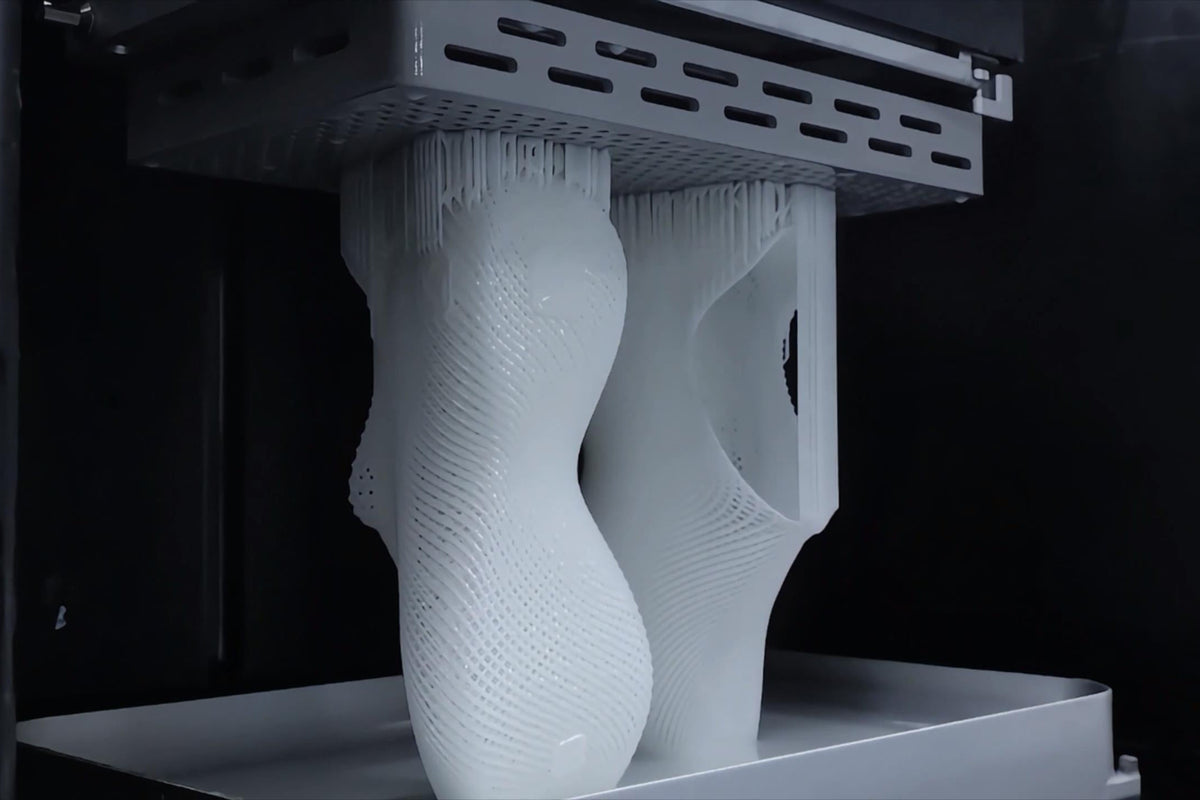
The third route is the family we work in. HALS is a continuous light-driven resin process, and its distinguishing claim is throughput rather than novelty: the point of continuous curing is that the part does not stop and start between layers, which removes the interlayer bond as the weak direction and, if the machine is arranged well, allows many parts to be produced in an uninterrupted cycle. We print our footwear on that route, with AI used in the lattice design rather than in the marketing. If you want the mechanics rather than the summary, what HALS printing is covers the process in detail, and our production system describes the printing and design setup.
The Three Routes Side by Side
| Material extrusion (FDM/FFF) | Vat photopolymerisation (DLS) | Continuous-cure resin (HALS) | |
|---|---|---|---|
| How the part is built | Melted filament laid down in paths | Liquid resin cured by projected light, layer by layer | Liquid resin cured continuously by light |
| Weak direction in the part | Between laid-down layers | Minimal, but layer interfaces exist | Solved for by continuous cure |
| Surface as printed | Visible layer lines | Smooth | Smooth |
| Typical footwear use | Prototypes, small-studio uppers and soles, custom designs | Production midsoles; whole printed shoes at retail | Whole printed footwear in a size run |
| Where it is strong | Cheap equipment, wide material choice, fast iteration | Established at production scale by a major brand | Throughput and one-piece parts |
| Where it strains | Speed, resolution, interlayer strength | Machine time per part | Newer in footwear, fewer suppliers |
What Everyday Wear Requires That a Showpiece Does Not
This is the part of the problem that has nothing to do with printing, and everything to do with shoes.
Comfort
A lattice is not comfortable because it is a lattice. It is comfortable when the density varies with the load: firmer under the arch and the outer heel, softer under the forefoot, and consistent enough that the foot does not hunt for a stable position between steps. Our approach is to let an algorithm vary the cell geometry zone by zone, then test the result on feet rather than on renders.
Breathability
An open lattice is genuinely different from a mesh upper over a foam midsole, for the simple reason that the open cells run through the body of the shoe rather than sitting on its surface. That is also why the drying behaviour differs from a foam shoe.
Durability
Foam loses height and rebound as its cells fatigue, which is why a worn pair feels flatter than a new one with nothing visibly broken. A printed lattice recovers geometrically within its designed range. It is not immortal — a lattice can crack if the design loads a strut wrongly, and a printed one-piece shoe cannot be resoled in the way a stitched shoe can. We publish our own fatigue testing in how long 3D-printed shoes last rather than asking you to take a claim on faith.
What We Test
Repeated compression on the midsole, tear resistance on the lattice, and wash-and-dry cycles, alongside ordinary wear over months.
Where Testing Still Falls Short
Laboratory cycles are not a pavement. Road miles on a real shoe are the only test that fully matters, and they take a year or more to accumulate. Treat any durability figure, ours included, as a signal rather than a guarantee.
Price
Price is where the custom era and the everyday line part company most sharply. A printed shoe cannot cost what a cheap moulded shoe costs, and any brand claiming otherwise is either subsidising the shoe or describing a different process — see the next section. What a printed line can do is hold a stable retail price as printing throughput improves.

How to Tell Which Process Made a Shoe
The word "printed" is not regulated, and a lattice appearance can be produced by a mould. Independent manufacturing documentation is direct about this: a Chinese footwear factory described in a published technical analysis used a 30-station rotary moulding line with EVA equipment to produce as many as 3,000 pairs of lattice-look shoes in 24 hours. The exterior shell carries a moulded lattice texture, a solid EVA insert sits inside it, and the parts are assembled (FacFox).
The useful part of that analysis is its conclusion: moulding is a legitimate, mature process, and the problem is not moulding. It is labelling. A moulded shoe sold as a moulded shoe is simply a moulded shoe. If you want to know what you are buying, appearance will not tell you. These will:
| What to look for | What it suggests |
|---|---|
| A visibly separate foam or EVA insert inside the lattice shell | An assembled moulded product |
| Parting lines, flash, gate marks or ejector marks | Moulding |
| Bonding lines, gaps or a material change between shell and cushioning | Two parts joined rather than one grown |
| Internal geometry that connects through the component, with undercuts | Additive manufacturing |
| A single continuous material from sole to collar with no upper panel | A one-piece printed shoe |
| A cross-sectional photograph rather than an exterior shot | The only view that genuinely settles it |
Two qualifications worth keeping in mind. First, the absence of moulding marks proves nothing, because they can be trimmed or hidden. Second, and more uncomfortable: a printed lattice does not automatically perform better than a well-made moulded one. Performance follows from geometry, material and process control, not from the method's reputation. Our longer treatment of this comparison, how to tell a printed shoe from an injection-moulded one, goes through the material and construction differences in detail.

What We Changed, and What We Did Not
One Piece Instead of an Assembly
Our shoes come off the printer as a single body: no stitched upper, no bonded midsole, no glue line between a shell and an insert. That removes the failure that owners of assembled shoes know best, where the sole separates from the upper at the point of the most flex. It also means the shoe cannot be resoled, which is a real trade and not a hidden one.

A Design We Could Actually Produce
The interesting design and the producible design are rarely the same file. Moving from custom to a size run meant accepting constraints — cell sizes the process holds reliably, wall thickness the material tolerates, a shape that survives being worn rather than photographed — and then using the freed capacity to make the shoe better rather than the marketing louder. The longer arc of that work, including the brands and processes that came before us, is covered in the full history of printed footwear.
What We Still Cannot Claim
We cannot claim a printed shoe is lighter than the best foam shoe, because in general it is not. We cannot claim that printing makes a shoe faster. And we cannot claim that a printed lattice is inherently superior to a well-engineered moulded sole, because that is not true either. What we can claim is narrower and more useful: a printed shoe can be worn as an ordinary shoe, replaced by buying the same shoe again, and made without tooling, which is what allows a size run to exist at all.

If You Are Buying Your First Printed Pair
What to Look For
Ask which process printed it, whether the body is one piece or an assembly, and what testing backs the durability claim. Those three answers separate a printed shoe from a shoe with a printed look. If the brand cannot say which process it uses, that is the answer.
Our Own Line
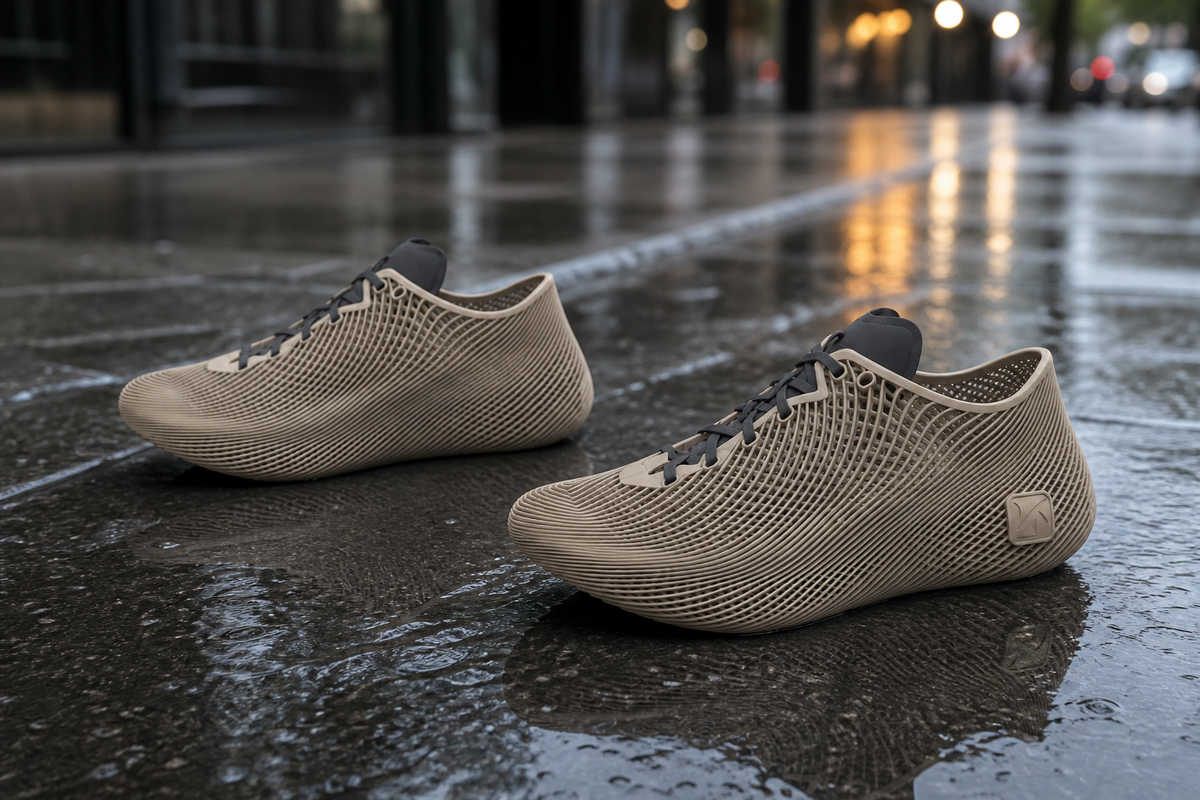
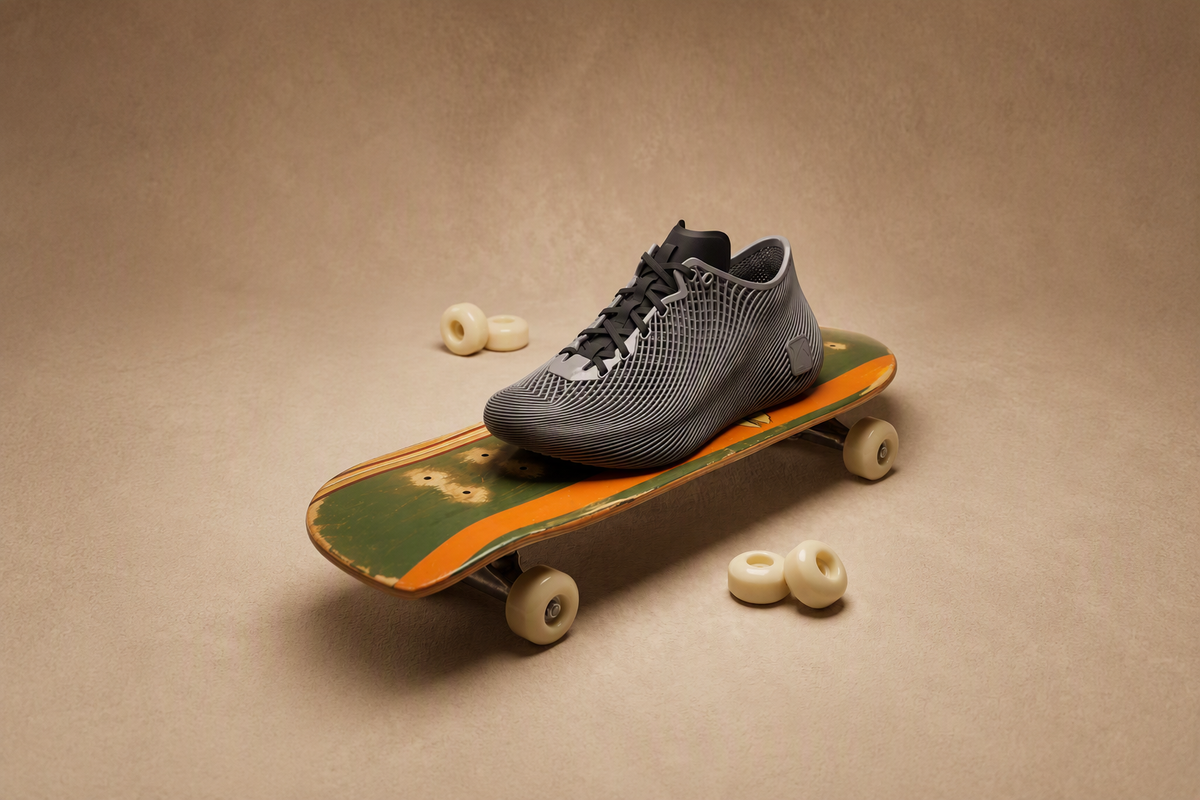
If you want to start somewhere sensible, two of our models cover most people. The AeroDash is the sport-leaning print and the better match for running, commuting and the gym, because its printed sole does the cushioning work without a foam layer to flatten. The AeroLace carries the same one-piece construction in a more everyday shape, which makes it the more sensible choice if a single pair has to work with trousers as well as shorts. Sizes and materials differ between models, so confirm them on the product page, and the full range is in the 3D printed footwear collection. This paragraph describes our own products and should be read as our description, not as an independent assessment.
Questions People Ask About Everyday Printed Shoes
Are 3D-printed shoes comfortable enough for all-day wear?
They can be, and the deciding factor is not the printing. It is whether the lattice density is varied to match how a foot loads, and whether the shape fits an ordinary foot rather than a scanned one. A printed shoe designed for a size run has to work for more people than a custom pair does, which is a harder design problem, not an easier one.
Can you wear printed shoes every day?
Yes, with the same caveats as any shoe. A one-piece printed shoe cannot be resoled, so when the sole wears through, the pair is finished. The upper and the lattice typically outlast the outsole, which is why we treat outsole wear as the end-of-life signal.
Is FDM the same as the printing used by the big brands?
No. FDM extrudes filament; the processes used in mass-market printed footwear cure liquid resin. Both are genuinely additive, and they produce different surfaces, different interlayer behaviour and very different production speeds. A shoe printed on a desktop FDM machine and a shoe printed in a continuous-cure resin cell are both printed, and they are not the same object.
Why do printed shoes cost more than moulded ones?
Machine time. A printed shoe occupies equipment for hours, and that time is billed whether the shoe uses a lot of material or a little. Moulding is the opposite: expensive tooling, then very cheap parts. At high volume, moulding will usually win on unit cost, which is exactly why printed footwear has to justify itself with things moulding cannot do — no tooling, no minimum order, and a size run that can be changed without new moulds.
Are printed shoes more sustainable?
The honest answer is that it depends on the comparison. Printing avoids tooling and lets a brand produce closer to demand, which addresses the industry's largest waste problem — the estimated one in five pairs thrown away unworn. Against that, printed footwear is currently harder to recycle at end of life than a shoe designed for disassembly, and resin supply chains are not automatically greener than foam ones. Fewer shoes made is a real gain; a printed shoe is not automatically a green shoe.
يشارك:
شُدّوا أربطة المستقبل: تعرّفوا على ARKKY AeroLace