

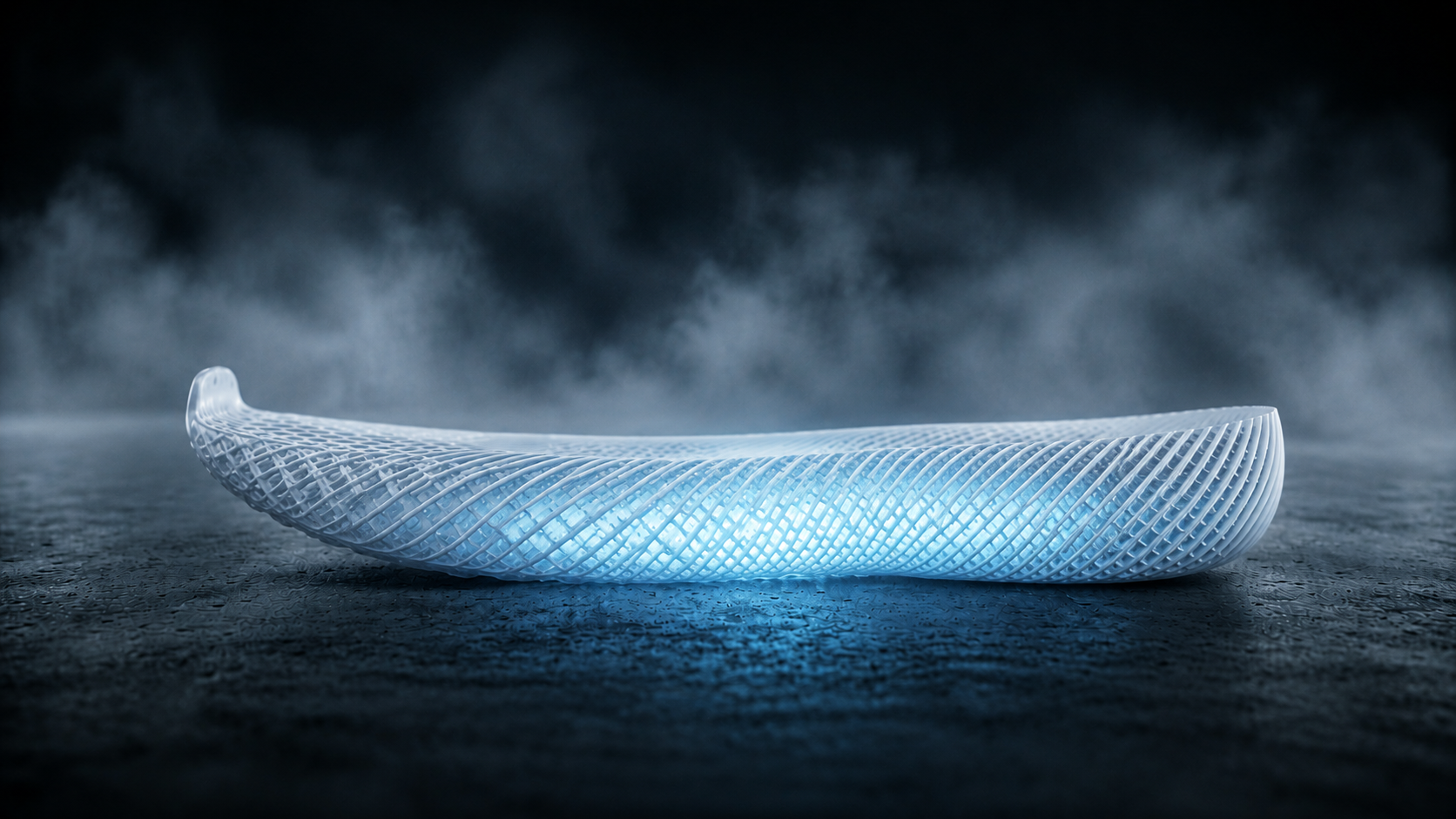

Understanding Young's Modulus
For decades, the footwear industry has chased a ghost: the perfect balance between cushioning and propulsion. Traditional foams like EVA or even high-end PEBAX have reached their physical ceiling. They are isotropic—meaning they react the same way regardless of the angle or specific pressure of your foot.
Arkky is moving beyond material limitations into the realm of computational physics.
By utilizing Young’s Modulus—the measure of a material's stiffness—and proprietary generative algorithms, Arkky has turned the shoe midsole into a dynamic, mechanical engine.
 (Fig: Macro comparison of fatigued EVA foam vs. pristine Arkky lattice structure)
Arkky vs. Adidas 4D: Why Zonal Density Matters
While Adidas 4D pioneered the 3D-printed look, it largely relies on a uniform or limited zonal structure.
"Most early 3D printed shoes are 'static'—they have a cool aesthetic but a limited functional gradient," says Dr. Aris Thorne, Lead Biomechanist at the Future Footwear Institute. "Arkky represents Lattice 2.0. It uses a truly continuous gradient."
 (Fig: Heatmap visualization of Arkky's variable Young’s Modulus)
Optimizing the Gait Cycle: A Three-Phase Response
Our algorithms don't just react to weight; they react to movement phases.
Ph.1: Initial Contact (The Decelerator)
As your heel strikes, the lattice struts are programmed with a specific "Buckling" logic. They collapse in a controlled, non-linear way to absorb the peak 2.5x G-force of your body weight.
Ph.2: Mid-Stance (The Stabilizer)
As the foot rolls forward, the algorithm increases the lattice density under the arch. This acts as a Digital Arch Support, preventing the foot from collapsing inward without the need for hard plastic shanks.
Ph.3: Toe-Off (The Accelerator)
This is where the Energy Return peaks. The lattice struts in the forefoot are angled at 45 degrees. As you push off, the stored strain energy is released forward, not just upward, acting like a miniature catapult.
 (Fig: Visual energy flow during the toe-off phase)
Case Study: The "Gravity-Defying" Experience
Subject: Marcus J., Semi-Pro Marathoner (PR: 2:38)
"With traditional carbon-plate shoes, I feel the 'pop,' but my calves are trashed after 20 miles because the foam loses its consistency," Marcus reports. "In the Arkky's, the bounce felt identical at mile 1 and mile 20. The transition from heel to toe felt like I was being guided by the shoe, not fighting it."
The "Mechanical Intelligence"
"We are seeing a shift from 'Chemical Intelligence' (foam chemistry) to 'Mechanical Intelligence' (lattice geometry)," notes Elena Volkov, Senior Materials Engineer and Peer Reviewer for the 2026 Arkky Whitepaper.
"Arkky's ability to tune the lattice for specific gait types—like correcting a supinator's strike pattern—is a game changer. It’s no longer just a shoe; it’s a wearable gait-correction device."
The Future is Parametric
The era of choosing between "soft" and "firm" is over. With Arkky, you get both, exactly where and when you need them. By mastering the art of energy return through algorithmic lattice density, we aren't just making a better shoe—we are optimizing the human stride.
Share:
Do 3D Printed Shoes Last Longer? 1,000-Mile Durability Test Results
Behind the Design: The AI Algorithms That Shape Arkky’s Lattice Structures