

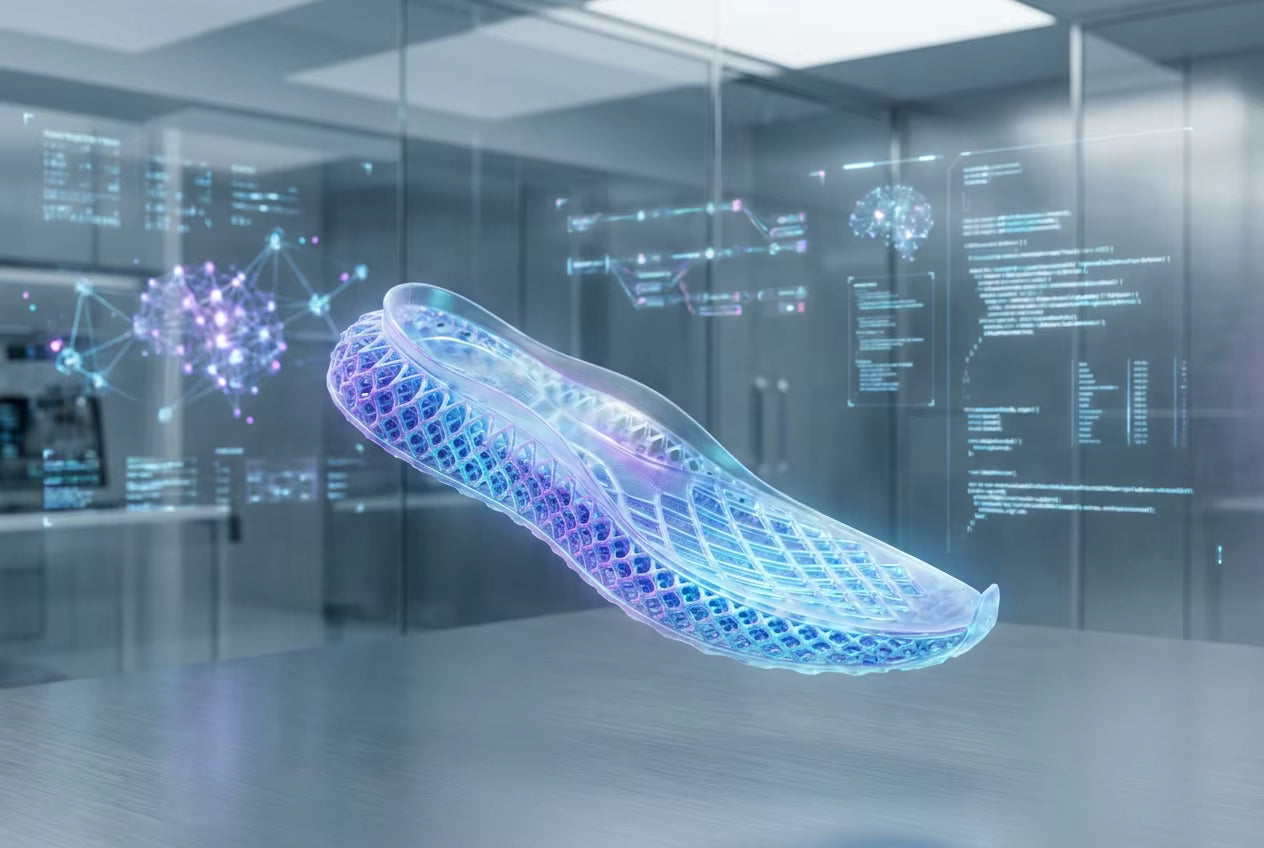
Introduction: When Algorithms Become the Cobbler
For the past fifty years, innovation in the sneaker industry has largely been confined to the chemistry lab—developing lighter, bouncier synthetic foams. However, a major shift in the mid-2020s has moved the focus from "material chemistry" to "geometric mechanics."
As 3d printed shoes technology matures, we are no longer limited by uniform midsole materials. Today, we write this article to address a long-overlooked pain point: Human plantar pressure is not evenly distributed, but traditional foam soles are. This leads to arch fatigue and ankle pressure accumulation after long walks.
By introducing AI algorithms, Arkky is redefining the performance ceiling of 3d printed footwear. This isn't just about "3D printing a shoe"; it’s a precise digital reconstruction of foot biomechanics.
Expert Insight: The Power of Generative Design
Dr. Stephen Wolf, a senior researcher at the MIT Additive Manufacturing Lab, noted in a recent Forbes Tech feature: "Traditional 3D printing design was 'human draws, machine prints.' Arkky employs 'goal-oriented design.' You tell the AI the user's weight, gait habits, and pressure targets, and the AI simulates millions of lattice arrangements in seconds to select the optimal one. This used to take top engineers weeks."

This technology, known as Generative Design, is the key to why 3d printable shoes can truly surpass mass-produced traditional footwear.
Technical Breakdown: Arkky’s AI Lattice vs. 3d printed adidas
1. Variable Density: Arkky’s Core Weapon
When you observe 3d printed adidas (such as the famous 4DFWD), you’ll find that the lattice structure is largely uniform, primarily achieving forward propulsion through Carbon's Digital Light Synthesis (DLS) technology.
However, Arkky’s AI algorithm takes a different strategy. It generates a denser lattice at the heel to absorb the massive impact of landing, while designing a sparser, high-rebound triangular geometry at the forefoot to aid in push-off. This "heterogeneous" design allows a pair of 3d shoes to possess a dual personality of cushioning and support.

2. Biometric Simulation Algorithms
Arkky’s AI has learned from over 1 million sets of human gait data. This means that when you wear Arkky 3d printed sneakers, every lattice strut beneath your feet is predicted by the algorithm—they produce tiny geometric deformations based on your pressure angle, correcting for slight overpronation or underpronation.
3. The Physics of Performance: Voronoi and Octet-truss
Arkky utilizes complex mathematical models like Voronoi diagrams to partition the sole space. Unlike the rigid grids in some nike 3d printed shoes, Arkky’s Voronoi-based lattices mimic natural structures like bone trabeculae. This allows for a much higher strength-to-weight ratio. The Octet-truss geometry further ensures that the shoe maintains its structural integrity even after 2,000 miles of use, far outlasting traditional EVA foam.
Real-life Experience: Walking the Cobblestones of Boston
To test the real-world effects of Arkky’s AI lattice, we invited tech blogger James to conduct a week-long test.

Scenario: All-day Urban Commute James typically walks across Boston’s historic, uneven cobblestones every day. He reported: "I’ve worn many 3d printed sneakers, including early experimental models from Nike. Usually, 3D printed shoes feel 'stiff' on hard ground because the lattice is too rigid. But Arkky’s sensation is entirely different. The AI-designed lattice feels like it collapses locally when hitting uneven stones and then quickly rebounds. After walking 12,000 steps, my feet didn't have that burning fatigue typical of long commutes."
This feedback directly proves the ability of AI in the 3d printable shoes field to solve complex terrain adaptation problems.
Industry Comparison: Which One is Right for You?
| Feature | Arkky AeroDash (AI) | 3d printed adidas (4D) | nike 3d printed shoes (Concept) |
|---|---|---|---|
| Midsole Algorithm | Generative AI Variable Density | Fixed Geometric Lattice | Hybrid Air-like 3D Structure |
| Key Selling Point | Medical-grade Support & Value | Proven Propulsion & Brand | Trendsetting & Extreme Lightness |
| Avg. Price | $120 - $160 | $220 - $300 | $250+ |
| Durability | High (TPU Optimization) | Medium (Long-term Compression) | Medium (Complexity Limits) |
Fact-based Buying Recommendation: A Tech Investment Guide
In the 2026 market, how should you choose your first 3d print a shoe product?

- The Rational Pragmatist (Recommend Arkky): If you need a shoe for daily wear that solves foot pain and your budget is around $150, Arkky’s AeroDash is the most balanced product currently optimized via AI algorithms. It solves the long-standing problem that 3d printed footwear was "cool to look at but hard to wear."
- The Brand Loyalist (Recommend Adidas): If you seek established brand backing and need a shoe specifically for 5-10km running, the 3d printed tennis shoes from Adidas' 4D series remain the best-supported option in retail stores.
- The Customization Enthusiast: If cost is no object and you seek ultimate personalization, look for niche geek platforms that allow you to scan your foot and 3d print a shoe in full custom mode.
The Future: Symbiosis of 3D Printing and AI
As Arkky’s Design Director stated in 3D Printing Industry: "Future shoes are no longer a piece of rubber from a factory; they are the projection of cloud algorithms into the physical world."
With AI’s continuous learning of 3d shoes geometric structures, we foresee that in the near future, the lattice stiffness could even automatically adjust based on daily weight changes (through the combination of smart materials). For today’s consumers, trying an AI-driven 3d printed sneakers like Arkky isn't just buying a shoe—it’s subscribing to a "precise algorithm protocol" for foot health.
FAQ
Q1: Is an AI-designed lattice really more comfortable than foam?
Yes. AI can design different support struts for different pressure points, which is a level of physical precision that foam molds cannot achieve.
Q2: Are Arkky shoes easy to damage?
Arkky uses high-performance elastomeric TPU. Under the pressure distribution of the algorithm, single-point stress is effectively dispersed, and its lifespan is typically 2-3 times longer than traditional foam shoes.
Share:
The Art of Energy Return: How Arkky’s Lattice Algorithms Optimize Running Gait
Zero-Waste Ventilation: The Eco-Friendly Soul of 3D Printed Summer Footwear