

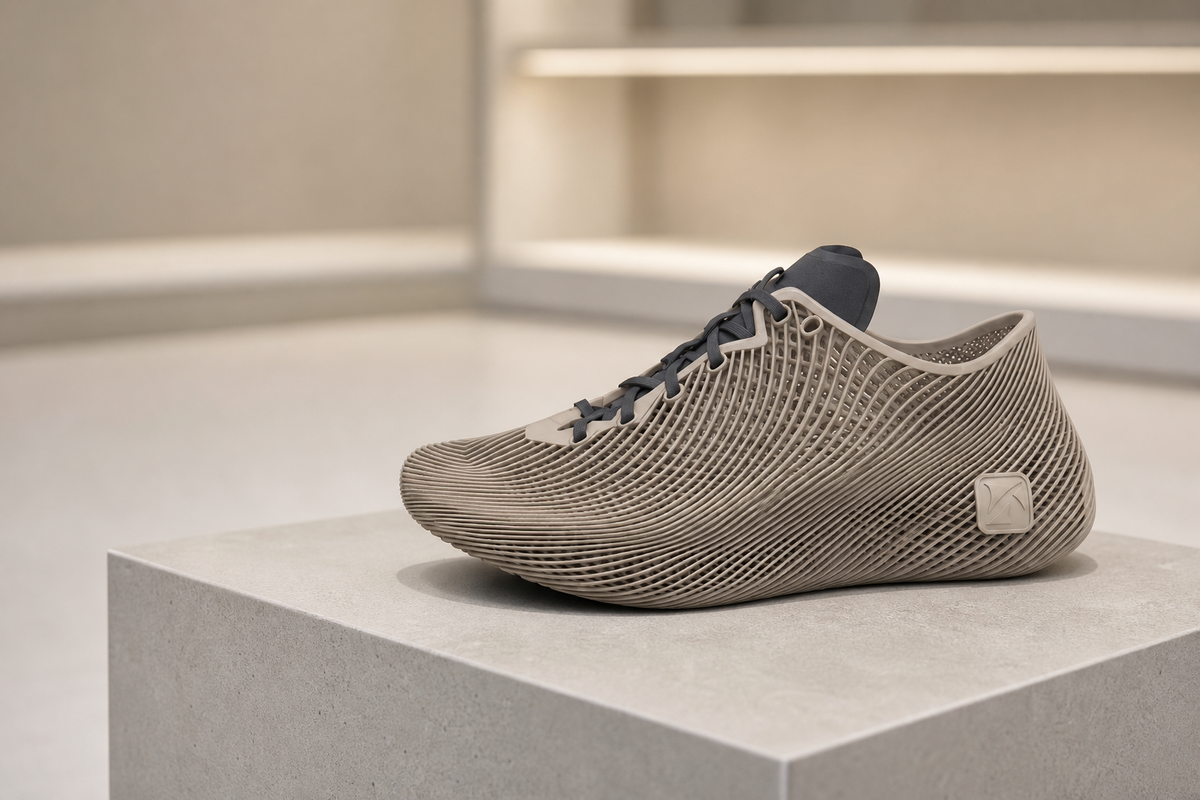
Most people meet a printed shoe the same way: they pick it up in a store, turn it over, and look for the seam. There isn't one. That small absence — no seam, no stitch, no join — is the visible tip of a change in how a pair of shoes can be made, and it has arrived at the moment the fashion business is under the most pressure it has faced on inventory.
The pressure is unusually well documented. The US Environmental Protection Agency counted roughly 17 million tons of textiles entering the American municipal solid waste stream in 2018, with 11.3 million tons landfilled and a recycling rate of 14.7% (US EPA). Globally the numbers are stated as a range rather than a figure: somewhere between 80 billion and 150 billion garments are produced each year, and between 10% and 40% of them are never sold (The Guardian, 2024). That reporting is worth reading closely, because it names the machinery behind the waste: manufacturers insisting on minimum order quantities, volume discounts that reward ordering more, retail cycles that demand constant newness, and buyers who would rather over-order than miss a sale.
Additive manufacturing removes two of those mechanisms outright — the tooling and the minimum order — and that is the reason the mass-market end of fashion has started paying attention. This article sets out what actually changed on the production side, which brands are already selling printed footwear at retail rather than in limited drops, what the cost structure looks like next to conventional shoemaking, and where the model still breaks. The evidence is first-party where a manufacturer publishes it, and third-party where an independent outlet has reported it; every figure below is labelled with which of those it is.

The Short Answer
What Is Pulling Fashion Brands Toward Printed Footwear?
Two things: tooling and inventory. Conventional shoemaking requires a mould for every component, a minimum order quantity to amortise that mould, and a forecast of demand that has to be right months before a single pair is sold. Additive manufacturing requires none of those. A printed shoe is produced from a digital file, so there is no mould to cut, no minimum run to commit to, and no finished inventory to write down if the forecast was wrong. Brands that live or die on sell-through — which is most of the mass market — are exposed to exactly the risk that printing reduces.
The Four Pressures Behind the Shift
- Tooling cost. Every size, colourway and silhouette change under conventional production means new moulds or new lasts. A printed shoe changes when the file changes.
- Minimum order quantities. The Guardian's reporting identifies MOQs as one of the reasons brands produce more than they sell. Printing has no meaningful MOQ.
- Inventory risk and markdowns. Unsold stock is the industry's chronic loss. Print-on-demand converts a finished-goods risk into a capacity question.
- Speed to shelf. A printed pair is manufactured in hours, not in a season-long factory cycle, which shortens the distance between a design decision and a sale.
Four Terms Worth Knowing
- DLS (Digital Light Synthesis). A continuous resin process using digital light projection, oxygen-permeable optics and programmable liquid resins. adidas uses it for CLIMACOOL.
- HALS (Hindered Asynchronous Light Synthesis). A related continuous-cure resin route rather than a filament one; ARKKY's implementation adds AI-driven design and production control.
- Tooling. The physical moulds and lasts a factory needs before it can make a shoe. The largest single barrier to small runs, and the first thing printing removes.
- MOQ (minimum order quantity). The smallest batch a factory will accept. It exists because setup costs have to be spread across a run.
What Actual Manufacturing Changed
No Mould, No Minimum, No Finished Inventory
The three constraints listed above are not commercial preferences; they are consequences of how moulded footwear is made. You cannot injection-mould one pair, because the mould costs the same whether it produces one pair or a hundred thousand. Printing inverts this. The marginal cost of the first unit is close to the marginal cost of the hundredth, which is why the industry's usual rationing device — commit to a big order to get a low unit price — simply does not apply.
The Unit Economics of a Printed Pair
The honest version of this story is that printing is not yet cheap. It is flexible. adidas prints the CLIMACOOL LACED over approximately 24 hours per pair using DLS, and sells it at $160 — a price that sits well above a conventional textile sneaker and well below the collector prices the first printed shoes commanded (adidas News, March 2026). Machine time, not material, is the dominant cost, and machine time is what falls as printer fleets scale.
Where the Price Comes From
A printed shoe's cost is dominated by how long it occupies a machine and how much that machine costs per hour. That is why every credible manufacturer is chasing throughput rather than material savings, and why the price of printed footwear has fallen as production cells have multiplied.
Why Print Time Is the Real Constraint
At roughly a day of machine time per pair, output is limited by the number of printers, not by the size of a factory building. This is a genuinely different scaling problem from conventional shoemaking, and it explains why the brands making progress in printed footwear are the ones investing in print capacity rather than in assembly lines.

Who Is Actually Selling Printed Shoes Today
adidas and the CLIMACOOL Line
adidas is the clearest case of a mass-market brand moving printed footwear from a raffle to a shelf. CLIMACOOL launched in September 2024 in limited quantities; by March 2026 the CLIMACOOL LACED was available worldwide in stores and online at €160 / $160 / £140, in unisex UK sizes 4–14. adidas describes the shoe as built over roughly 24 hours of DLS printing, with no edges or joins, size-specific cushioning printed into every pair, and a shell 15% lighter than its 2025 models. The company has kept the line moving since, announcing Futurecool in August 2026 as what it calls the next era of 3D-printed footwear (adidas News, August 2026).
Nike's Air Max, Printed by Zellerfeld
Nike's printed Air Max is not made in a Nike factory. It is produced by Zellerfeld, the Hamburg-based 3D-printed footwear manufacturer, whose facilities in Austin, Texas and Hamburg run what the company describes as thousands of printing units capable of turning digital designs into shoes without moulds, stitching or assembly. The same company has since integrated foot-scanning hardware into its pipeline so that a scan taken in a store feeds directly into the print job, and has previewed a printed Christian Louboutin derby alongside its own range (WWD, July 2026).
Why a Platform, Not a Factory
The Zellerfeld model is worth understanding on its own terms. Instead of a brand buying printers, a print platform sells capacity to brands and takes the manufacturing risk out of their hands. That structure is what makes printed footwear accessible to labels that would never build a print line themselves — including, in the cases above, a sportswear giant and a luxury house.
What the Big Names Have Shipped
| Brand | What it shipped | Process route | Availability |
|---|---|---|---|
| adidas | CLIMACOOL, then CLIMACOOL LACED, and Futurecool announced | Digital Light Synthesis (DLS) | World retail from March 2026; $160 |
| Nike | Printed Air Max range | Printed by Zellerfeld | Direct-to-consumer, limited drop model |
| Christian Louboutin | Printed derby previewed by Jaden Smith | Printed by Zellerfeld | Not yet at retail |
| Reebok | Printed footwear releases | Third-party print routes | Limited releases |
| Dior, New Balance, Fendi | Printed limited editions | Mixed | Limited releases |
Availability and pricing in this table are as published by the brands named, or as reported by WWD in July 2026. Nothing in it should be read as a claim about current stock.
Conventional Production Versus Printed On-Demand
| Conventional moulded production | Printed on-demand production | |
|---|---|---|
| Tooling | A mould or last per component, size and colourway | None; the digital file is the tool |
| Minimum order | Set by the factory; typically thousands of pairs | Effectively one pair |
| Lead time from design to shelf | Months, across sampling, tooling and shipping | Hours per pair, plus finishing |
| Inventory risk | Finished goods owned before demand is known | Produced against a file or an order |
| Design iteration cost | New mould or new last | New file version |
| Waste profile | Offcuts, unsold stock, samples | Near-zero material waste reported; unsold units are still a risk |
| Colour and finish range | Wide, and cheap to vary | Narrower; multi-colour printing remains the hard problem |
| Unit cost at scale | Falls steeply with volume | Less volume-dependent; dominated by machine time |
| Unit cost at low volume | Punishing, because of tooling | Roughly flat |
How to Read the Table
The table is not an argument that printing wins on every line. It loses badly on colour variety and, at very high volumes of a single simple design, conventional moulding can still be cheaper per pair. What printing changes is the shape of the cost curve: it removes the penalty for producing small numbers of many designs, which is precisely the situation in which fashion brands operate.
Where Conventional Production Still Wins
Complex multi-material uppers, embroidery, leather goods and anything requiring a wide palette are still made the traditional way, and should be. Printing has not replaced shoemaking; it has opened a different segment of the market, one defined by design variety rather than volume.
How a Printed Pair Reaches a Customer
| Step | What happens | Why it matters commercially |
|---|---|---|
| Fit capture | A foot scan or a stated size builds a fit profile | Removes some of the sizing guesswork that drives returns |
| File preparation | The shoe geometry is generated and adjusted digitally | No tooling lead time; changes are versioned, not re-moulded |
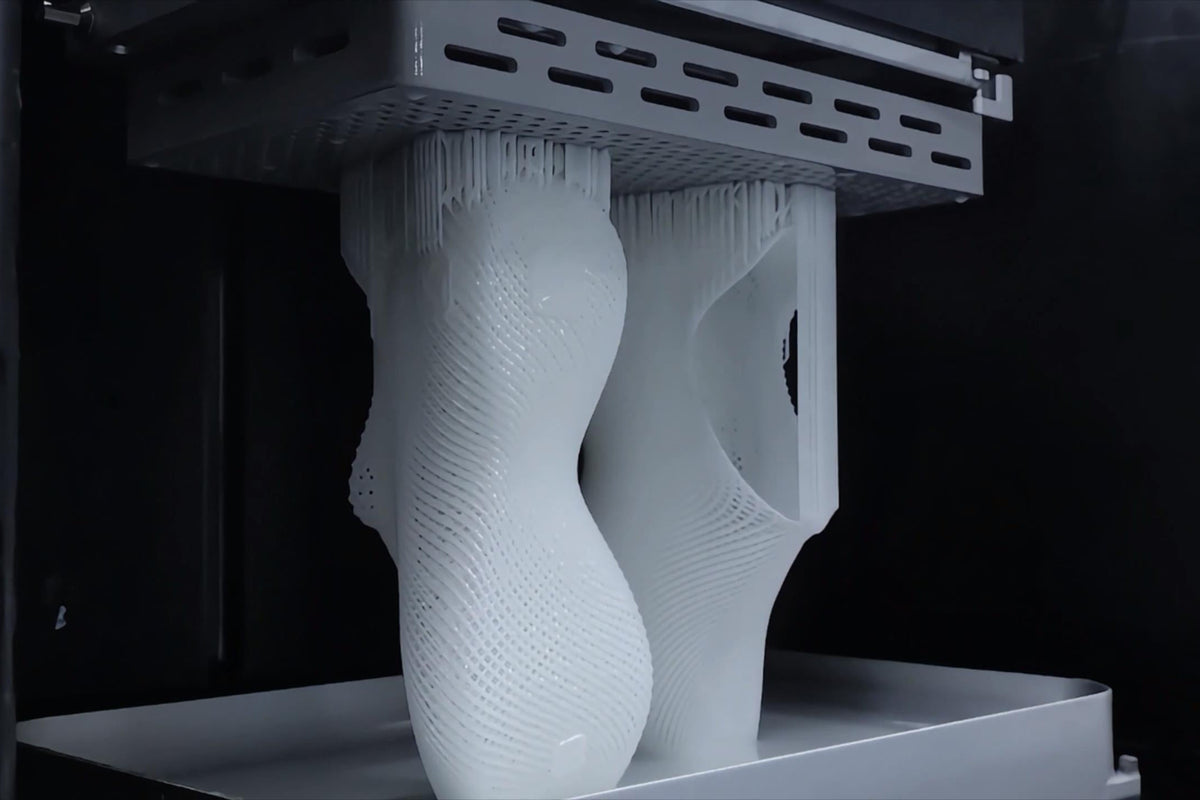
| Printing | The pair is printed — adidas states roughly 24 hours per pair | Capacity, not factory floor space, sets output |
| Finishing | Cleaning, curing and any added components | Where most manual labour now sits |
| Dispatch | The pair ships from a print site to the buyer or store | Shorter, more predictable supply chain than seasonal shipping |
Why the Fit Step Matters More Than It Sounds
Returns are one of the quiet costs of selling shoes online. A printed shoe can be manufactured to a profile rather than selected from a size grid, and the platforms moving fastest in this market have built their pitch around exactly that. It does not eliminate returns, but it changes what a wrong fit costs.

Where the Model Still Breaks
Unit Cost
Printing is not yet the cheap option. At $160 a pair for a fully printed adidas sneaker, printed footwear sits at the top of the mass-market band and relies on a customer who wants the design or the material story, not merely the lowest price. Third-party market estimates illustrate how young the category is: for 2026 alone, published figures range from roughly $2.2 billion to $4.95 billion depending on the research house, which is a spread wide enough to make any single number unreliable.
Colour and Multi-Material Limits
Printing one part in one material is solved. Printing several materials with distinct mechanical properties into one shoe is not, and printing consistent multi-colour product is still the harder problem. Brands that need a wide palette still need conventional production for most of the range.
Fit, Returns and Resale
A printed shoe cannot be resoled or repaired the way a stitched shoe can, and the resale market for printed footwear is thin. Both facts matter to a buyer weighing a printed pair against a conventional one, and neither is a technology problem — they are consequences of a one-piece design.
What Would Have to Change
Three things: print throughput per machine, the number of materials a single build can combine, and end-of-life handling. The first is progressing fastest, which is why the price points have already fallen from collector territory to retail.
What This Means If You Are Buying
What to Look For
Ask which process produced the shoe, how long it spends on the machine, and what happens to it when it wears out. Those three questions separate a product from a demonstration, and a manufacturer who can answer them is one worth buying from. The same reasoning is set out in more detail in ARKKY's article on how long 3D-printed shoes actually last, which reports the company's own fatigue testing.
Where the Process Is Explained
If you want the technical detail before you buy, ARKKY's explanation of HALS printing sets out how a continuous-cure resin process differs from layer-by-layer printing, and the production system page describes the AI-driven design and printing setup the company calls AI-HALS.
Shoes Built on a Printing Line
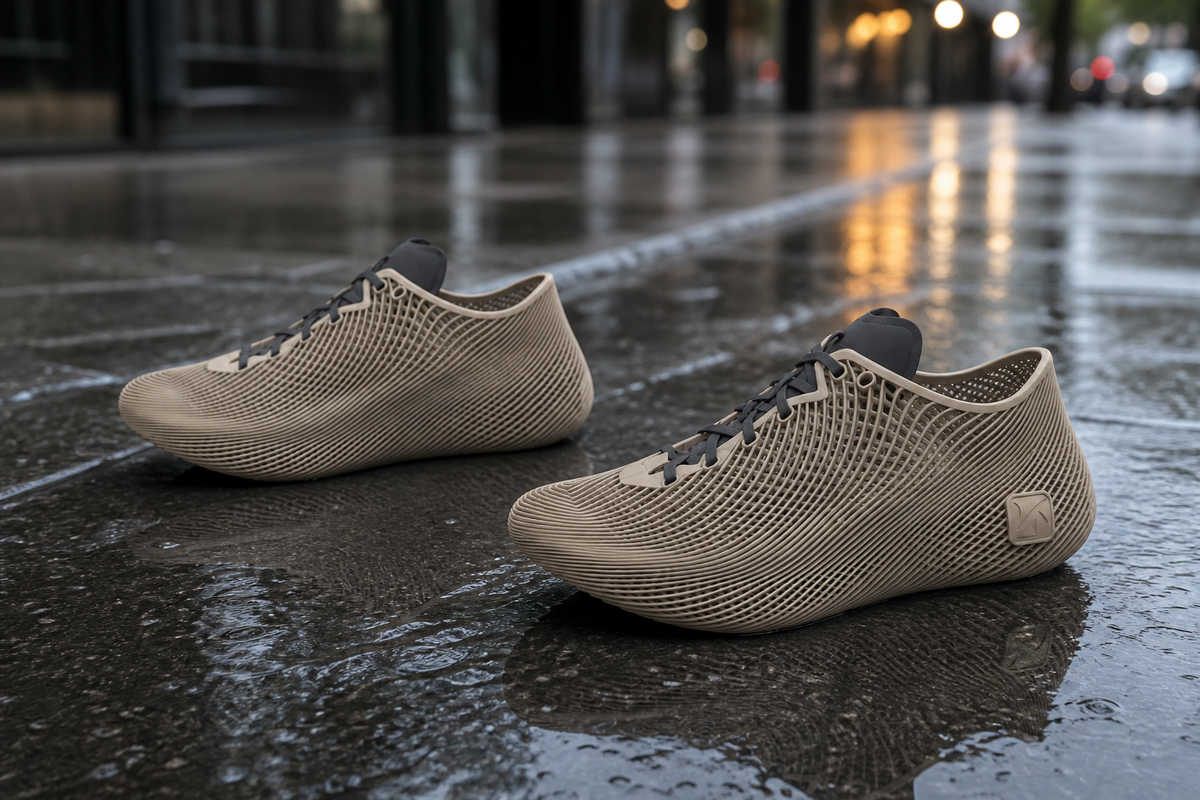
ARKKY's range is produced on its own AI-HALS line rather than assembled around a printed component, which puts it in the same broad category as the brands above. Three options cover most buyers. The AeroDash is the sport-leaning model, and it makes sense if you want one pair for commuting and light training. The AeroLace carries the same construction in a more everyday shape for people who would rather not wear a technical silhouette to work. The CozLite 101 and CozLite 305 are slipper-style prints with the least enclosed structure, which is why they are the most comfortable option in humid or wet conditions. Sizes and materials differ between models, so confirm them on the product page; the full range sits in the 3D printed footwear collection. Everything in this paragraph is the company's own description of its products and should be read as such.
Questions People Ask About Printed Footwear
Is a printed shoe more sustainable than a conventional one?
It depends which part of the footprint you mean. On material waste and tooling, printing has a clear advantage: a printed shoe uses close to the material it needs and needs no moulds, so there is no tooling waste and no minimum batch to over-produce. On end-of-life, the picture is mixed, because a one-piece printed shoe cannot easily be separated into recyclable streams, and unsold printed units are still unsold units. The strongest environmental argument for printing is the one about volume: a manufacturing system that can produce one pair profitably removes the commercial reason to make a hundred thousand and hope.
Why do printed shoes cost more than moulded ones?
Because machine time dominates the cost. adidas quotes roughly 24 hours of printing per pair, and that time has to be paid for regardless of how much material the shoe uses. Conventional production spreads its setup costs across a large run, which is exactly what printing refuses to do. As printer fleets grow and machines run faster, this gap narrows — which is what has already moved printed footwear from collector prices down to retail.
Will printing replace shoe factories?
Not on current evidence. The brands closest to scale still print a single-material silhouette and still finish by hand; complex uppers, wide colour ranges and leather goods remain conventional. What printing does is take over the part of the market that was always badly served by moulds: small runs, fast design changes, and personalised fits.
Do printed shoes last?
A printed lattice avoids the compression set that flattens foam midsoles, because it recovers geometrically rather than relying on cell walls to spring back. The corresponding risks are strut fatigue and, in filament-printed shoes, failure along the layer bonds. Durability therefore depends far more on the process family and material than on the fact that the shoe was printed — a distinction covered in detail in this site's article on what separates a wearable printed shoe from a printed model.
Compartir:
Travel Light: Why ARKKY 3D Shoes is the Ultimate Travel Companion