

In the sweltering heat of summer, "breathability" in footwear is often a marketing illusion. You might be wearing sneakers covered in mesh, yet your feet feel like they are enduring a miniature sauna. This article dives deep into the structural flaws of traditional mesh shoes and reveals how 3D printing technologies like HALS and DLS are revolutionizing heat dissipation.
The "Micro-Sauna" Paradox: Why Mesh Does Not Equal Airflow
When we look at a pair of traditional "breathable" running shoes, our eyes see porous mesh, but our feet feel damp heat. This phenomenon is known as the Micro-Sauna Effect.
The Multi-Layer Blockade
Traditional mesh sneakers are never just one layer. To provide support and durability, manufacturers add linings, support overlays, and foam padding beneath the outer mesh. Crucially, these layers are bonded with adhesives (glue). This glue layer acts as an invisible barrier, trapping heat and moisture within the gaps of the fibers and chemicals.
Heat Absorption in Synthetic Fibers
Most mesh is made from polyester. According to Woolmark studies on textile thermal comfort, synthetic fibers heat up rapidly after absorbing body heat and lack the cooling efficiency of natural fibers or physical air cavities.
3D Printed Integrated Molding: A Revolution in Physics
Unlike the "stacking" logic of traditional mesh shoes, 3D printed footwear utilizes a "subtractive" logic.
Adidas & Carbon: The Pioneers of DLS Technology
The Adidas 4D series employs Digital Light Synthesis (DLS) technology from Carbon. It cancels the traditional foam midsole and glue layers, allowing heat to escape vertically through the open gaps.
HALS Technology: Speed Meets Ultra-Precise Geometry
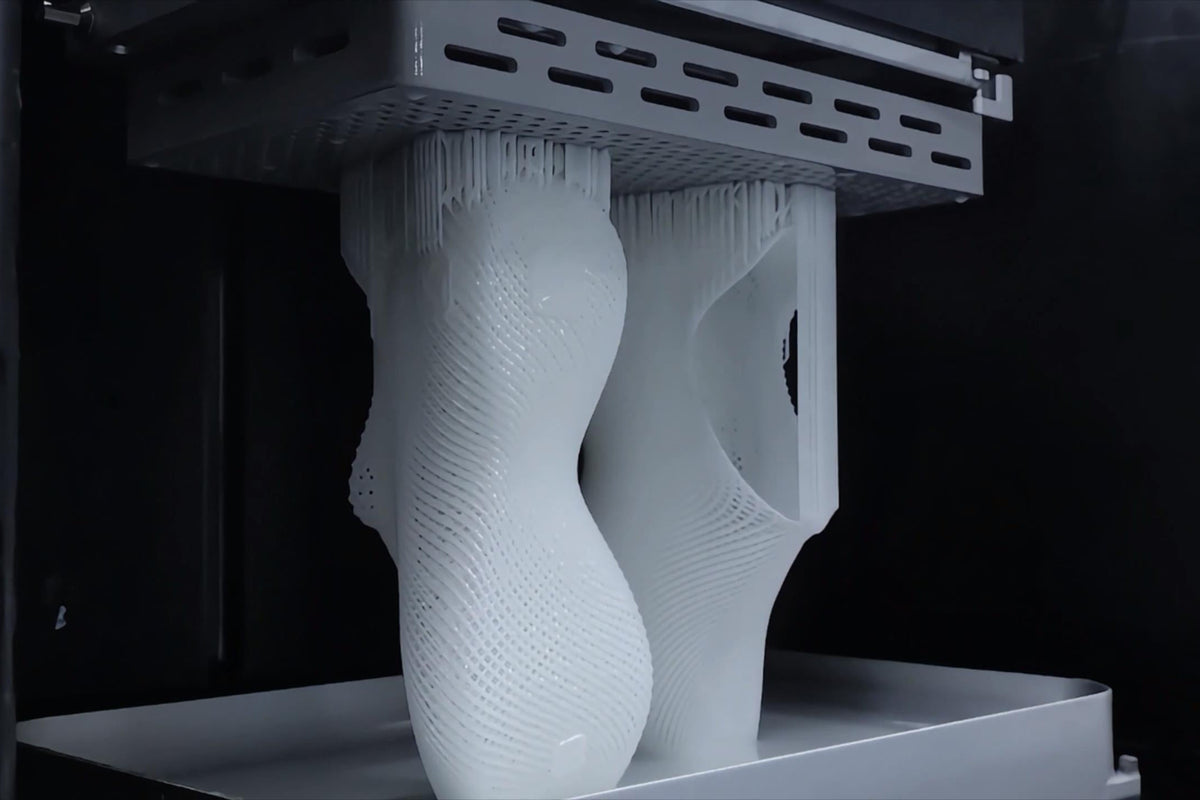
HALS (High-Area Lithography System) represents the next generation of technology. This Integrated Molding process means the sole and upper can be produced as one continuous entity, where every support point is essentially a miniature ventilation duct.
The Thermal Imaging Verdict: Seeing the Heat Escape
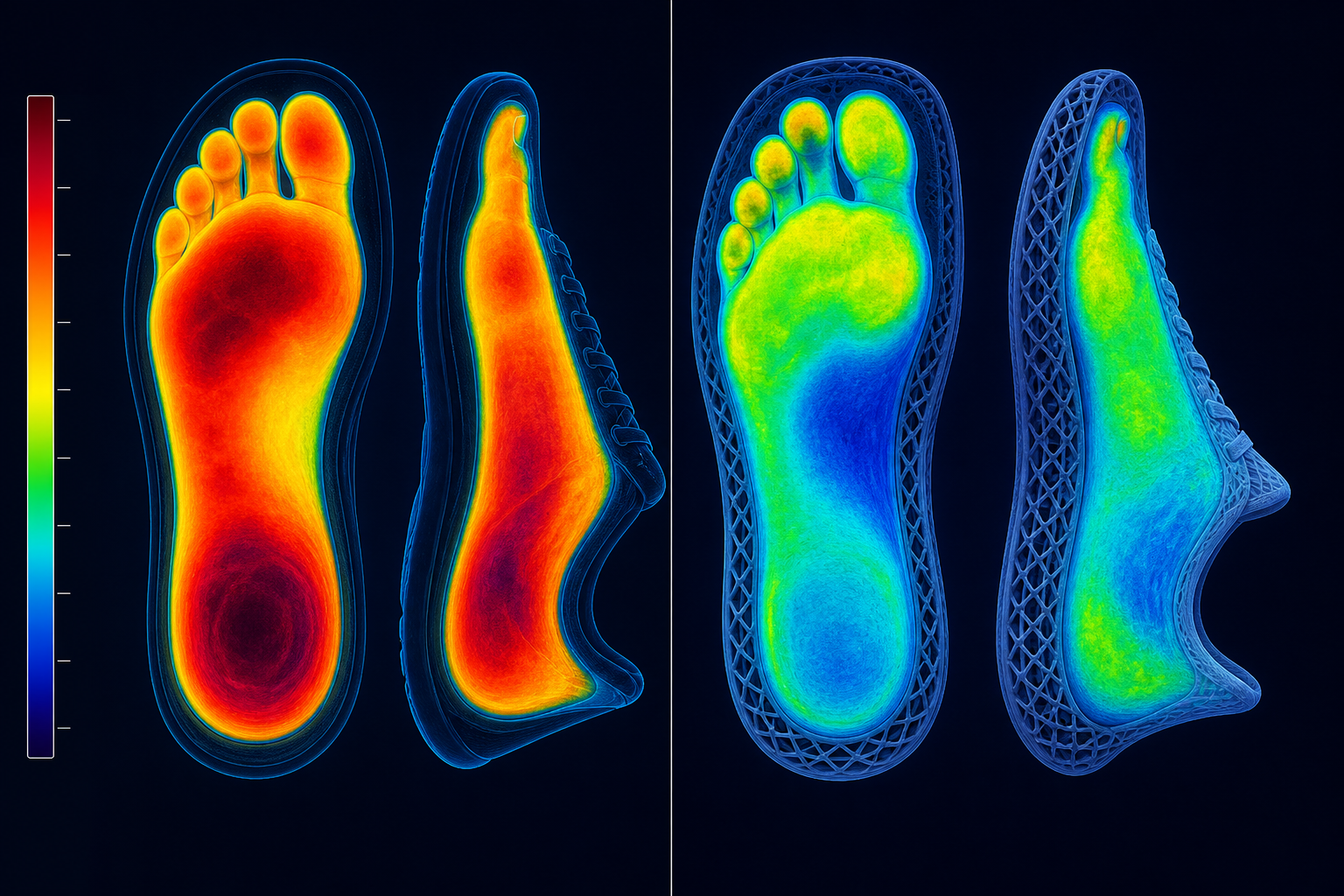
Laboratories compared traditional mesh runners with 3D printed lattice shoes using infrared thermal cameras.
Static Heat Accumulation (Standing Still)
After standing for 10 minutes, traditional mesh shoes showed dark red heat pooled due to lack of convection. In contrast, 3D printed shoes showed a uniform orange-yellow distribution, indicating continuous natural dissipation.
Active Cooling During Movement
The lattice structure creates a "Bellows effect": every footstrike pumps hot air out and sucks cool air in. Infrared footage showed that 3D printed shoes cooled down nearly 40% faster than traditional mesh shoes.
Comparison Table: Traditional Mesh vs. 3D Printed Lattice
| Feature | Multi-layer Mesh Sneakers | 3D Printed Lattice Sneakers |
|---|---|---|
| Structural Layers | 3-5 layers (including lining & glue) | 1 layer (integrated physical cavity) |
| Cooling Principle | Moisture wicking (Passive) | Physical convection (Active) |
| Heat Dissipation Speed | Slow (Heat absorbed by foam) | Extremely Fast (Physical exhaust) |
| Dryness Performance | Absorbs water; dries slowly | Water-resistant; instant rinse |
| Core Technology | Textile Weaving | HALS / DLS Additive Manufacturing |
FAQ: Everything You Need to Know About Cool Feet Tech
Q: If 3D printed shoes are so breathable, will they be too cold in winter? A: Yes. 3D printed lattice shoes are best suited for warm climates or indoor gyms due to their extreme heat dissipation.
Q: Does the lattice structure trap stones easily? A: Modern lattice designs (produced by HALS) are geometrically optimized to prevent large debris while maintaining high sand-shedding performance.
Conclusion: Evolution Driven by Physiological Needs
Upgrading to 3D printed sneakers powered by HALS or DLS is no longer just about a futuristic aesthetic—it is about allowing your feet to escape an invisible "micro-sauna."
Compartir:
Más allá del plástico: Durabilidad y estabilidad del TPU en el calzado de alto rendimiento
Lateral Stability in 3D Footwear: Solving the Wobble Effect