

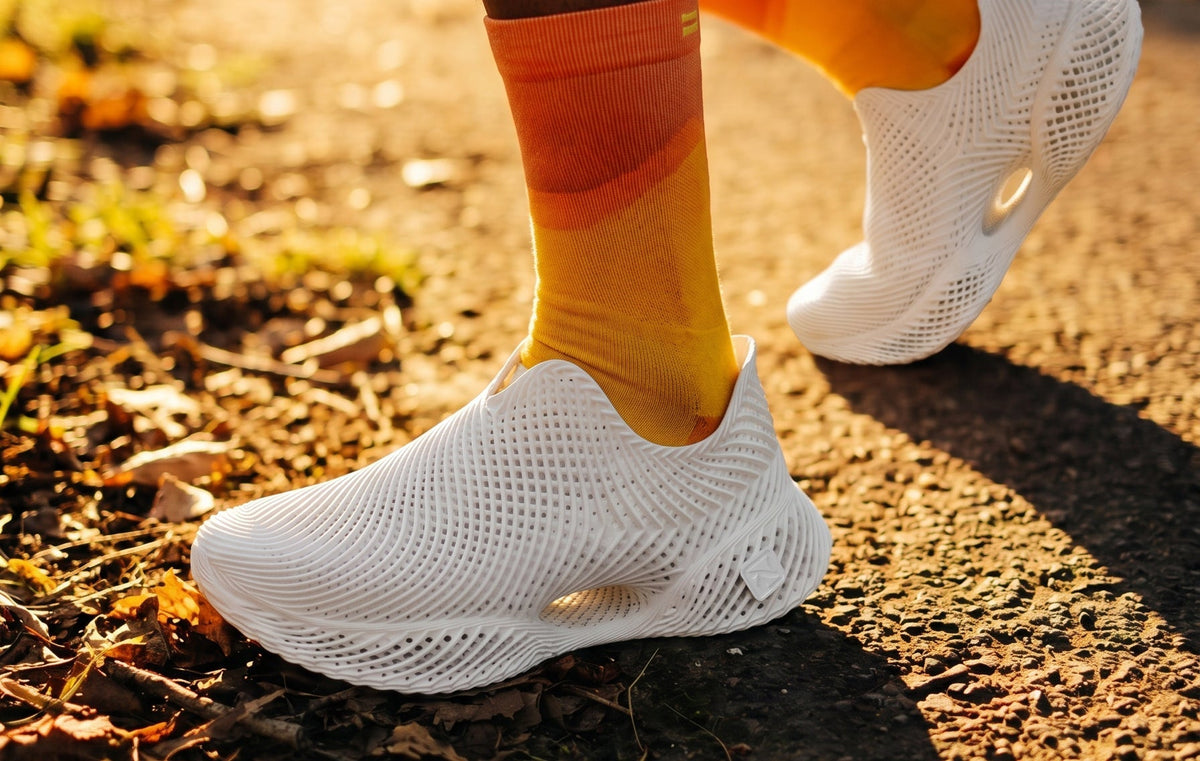
It usually announces itself in the first twenty minutes of a run or the third set of a tennis match: you plant on the outside of your foot, and for half a second the shoe gives way underneath you before the rest of your body catches up. Most runners write it off as tired ankles. But the numbers say otherwise. Roughly two million ankle sprains are reported every year in the United States, and the large majority of them involve the ligaments on the outer side of the joint — the same structures that are stressed in that brief sideways give (StatPearls, NCBI Bookshelf). Up to 40% of people who sprain that outer complex once go on to develop chronic ankle instability, a condition where the joint never quite feels trustworthy again (Hertel & Corbett, Journal of Athletic Training, 2019).
What surprised us when we started designing around this problem is that the footwear world talks about "stability" almost exclusively in one direction — the arch. Medial support for overpronation is a mature, well-documented category. The outer edge, where most ankle sprains actually happen, barely gets a mention, and there is no dedicated category for it. This article is our attempt to fill that gap in plain language: what the wobble effect is, why it is fundamentally a geometry problem, how 3D-printed zonal lattice density addresses it in ways foam cannot, and how you can judge lateral support with your own hands before spending money. Along the way we will show you why recent gait research on printed lattice midsoles matters for everyday buyers (Scientific Reports, Nature Portfolio, 2025), and we will be honest about where shoes can and cannot help an unstable ankle.
What the wobble effect actually is
The wobble effect is the sensation that the outer edge of your shoe compresses and rolls under your foot during sideways load — usually during a cut, a step-down, or a landing on uneven ground — leaving the ankle briefly unsupported before the ligaments take over.
That description matters because it separates two problems that the shoe industry tends to merge. Overpronation is a medial story: the arch collapses and the foot rolls inward (eversion), so stability shoes add a denser post on the inside of the midsole to slow that motion. Lateral instability is the opposite edge: the foot rolls outward over the little-toe side (inversion), and the structures that stop it are the lateral ligament complex — the anterior talofibular ligament first, then the calcaneofibular — plus the muscles that control the outer side of the ankle. Footwear clinicians have pointed out for years that almost the entire stability category is built around the medial story, while people whose problem is the outer edge — whether from a past sprain or simply narrow, easily rolled shoes — have far fewer options (Doctors of Running). Calling a shoe "stable" because it controls the arch tells you very little about whether it will hold you on the outside.
Why the arch conversation doesn't answer the wobble question
If you search for lateral support shoes, most results still point you at motion-control and overpronation models. That advice is useful if your arch collapses; it is almost irrelevant if your issue is inversion. A medial post does nothing to resist the outer edge rolling under. It is possible — common, even — to have a "stability" shoe that feels perfectly planted on the inside and wobbly on the outside. When you shop, the question is not "is this a stability shoe" but "where in this shoe does the structure live, and is it where my foot needs it?"
The anatomy of a rollover

Picture the worst-case step: your foot lands slightly wide of your center of mass, the outside of the heel strikes first, and body weight keeps traveling sideways while the foot tries to stop it. The sole pivots on its outer edge and the ankle rolls inward over it — that inversion motion is the mechanism of most lateral ankle sprains, and roughly half of all ankle sprains happen during athletic activity of exactly this kind (Waterman et al., J Bone Joint Surg Am, 2010).
Three structures resist that motion, and a shoe can help with each of them. The first is the lateral ligament complex, which is the final brake — once it stretches, you have a sprain, and repeat stretching is what produces chronic instability. The second is the peroneal muscles, which actively pull the foot back to neutral; shoes cannot strengthen them, but a stable platform gives them a firmer surface to work from. The third is the shoe itself: how wide the base is, how far the midsole flares under the outer heel, how rigid the heel counter is, and — the part that barely existed until printing matured — how the midsole material behaves under sideways compression.
That third structure is the one engineering can actually change, which brings us to how the industry has tried to change it so far.
Four ways shoes have tried to control the outer edge
Before lattice printing, designers had a handful of mechanical tricks, and each one is a compromise:
- Medial posting (dual-density foam). A firmer block of foam on the inside edge. Effective for arch collapse, nearly silent on the outer edge.
- Guide frames and rails. A firmer frame wrapped around the heel or along one side of the midsole, intended to steer rather than block motion. Again, the classic implementations put the structure medially or posteriorly.
- Stiff heel counters and outsole flares. A rigid cup around the heel plus a widened, flared sole increases the base of support and stops the shoe rolling on its outer heel. This genuinely helps lateral stability, which is why court shoes and hiking boots lean on it — but it adds stiffness and weight, and a heel counter does nothing for the forefoot, where cuts and push-offs also happen.
- Thicker, softer foam. The default modern answer to comfort. It cushions beautifully and wobbles proportionally, for reasons we will look at next.
None of these approaches can place a lot of firmness on the lateral edge while keeping the rest of the midsole soft — foam is made in slabs and molds, so density changes require either glued layers or a compromise everywhere else.
Why tall foam stacks make the wobble worse
There is a physical reason the wobble got more noticeable as shoes got taller, not less. Think of the shoe as a lever. The higher the stack — the further your ankle sits above the ground — the longer the lever arm, and the more the midsole has to resist sideways tipping for the same body weight. A soft, uniform foam under that lever simply shears and squashes on the loaded side. Two shoes made of identical foam will differ enormously in lateral steadiness purely from stack height and base width.
There is also a less obvious geometry problem: most modern midsoles are rounded, and many are rockered, to smooth the gait cycle. A curved outer edge is excellent for rolling forward and mediocre at resisting rolling sideways. When a designer rounds the sole for a smoother ride, lateral-edge support quietly leaves the building. That is why a tall, heavily rockered "max cushion" shoe can feel glorious on a straight road and nervous on a trail edge or during a quick change of direction — it is not in your head, and it is not your ankle weakening. The geometry is doing exactly what it was drawn to do.
Zonal lattice density: geometry doing what foam cannot

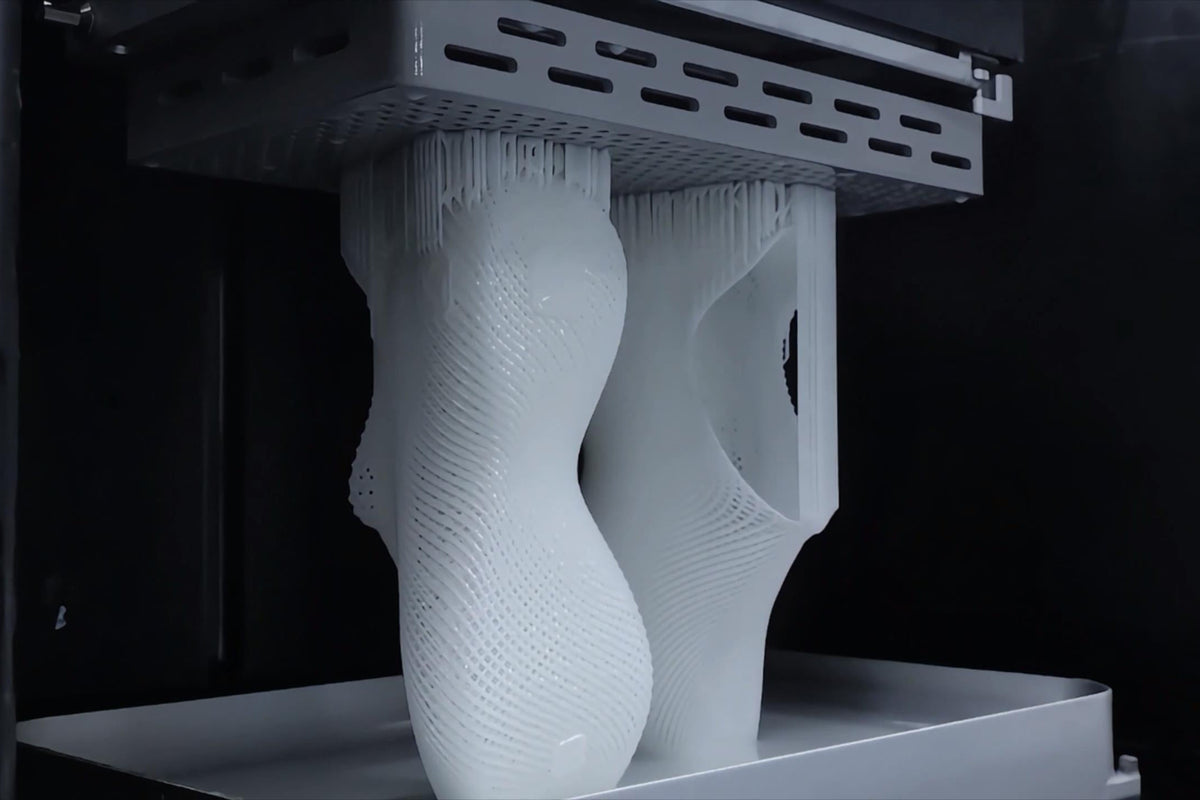
This is where 3D printing stops being a gimmick and starts being a different way of building. A printed midsole is not a block of material with a shape; it is a lattice — thousands of tiny struts and unit cells — and the mechanical behavior of that lattice is decided by its geometry, not by its material recipe. Print the cells denser, with thicker struts, and that region behaves like a much firmer foam. Print them more open, and the region stays soft. Crucially, because the whole midsole is built cell by cell from one material, the transition between firm and soft regions can be continuous — no glue lines, no separate pieces, no weight penalty from a second material. This is what footwear engineers mean by zonal lattice density, sometimes called variable-density or zone-tuned cushioning: stiffness is placed precisely where the foot needs it and removed where it does not.
For lateral support, that means the outer edge of the midsole — the strip that takes the load in the wobble moment — can be printed with a denser, more inversion-resistant structure, while the central heel and forefoot stay open and cushioned. The shoe becomes firm on the outside where you roll, and soft in the middle where you land. A foam midsole cannot do that without glued dual-density layers; a printed midsole does it as a single part.
What recent gait research actually shows
The engineering theory is one thing; measured behavior is another. A 2025 study in Scientific Reports tested running shoes fitted with 3D-printed biomimetic midsoles built from lattice patterns and measured foot pressure distribution and balance during walking, running, and jumping. The authors found that the pattern of the lattice significantly changed heel rotation and medial–lateral foot balance — one Voronoi-derived structure reduced foot-balance imbalance by roughly 7.5% during running and about 5% during jumping compared with another printed pattern, and it improved the stability of the stance phase while reducing swing-phase imbalance (Li, Jung & Lee, Scientific Reports 15:8399, 2025). The same paper also notes that some printed soles use auxetic lattice cells with a negative Poisson's ratio, which densify under compression — a useful property for a midsole that should get firmer exactly when you load it sideways.
A few caveats keep us honest. This is one study, on a limited set of structures, and the differences it found are between printed patterns rather than between printed and foam shoes. The point is not that printing has "won" — it is that geometry measurably changes lateral balance, which is precisely the lever that zonal density gives designers to work with. The industry's most visible printed midsole to date, adidas's 4DFWD, was engineered around a different goal — converting vertical impact into forward motion through an anisotropic lattice — and even that single-material lattice was zone-tuned between heel and forefoot (adidas blog). Directional, zone-tuned lattices are proven manufacturing territory; using that same idea in the lateral direction is the logical next step rather than science fiction.
Reading a 3D-printed midsole with your eyes
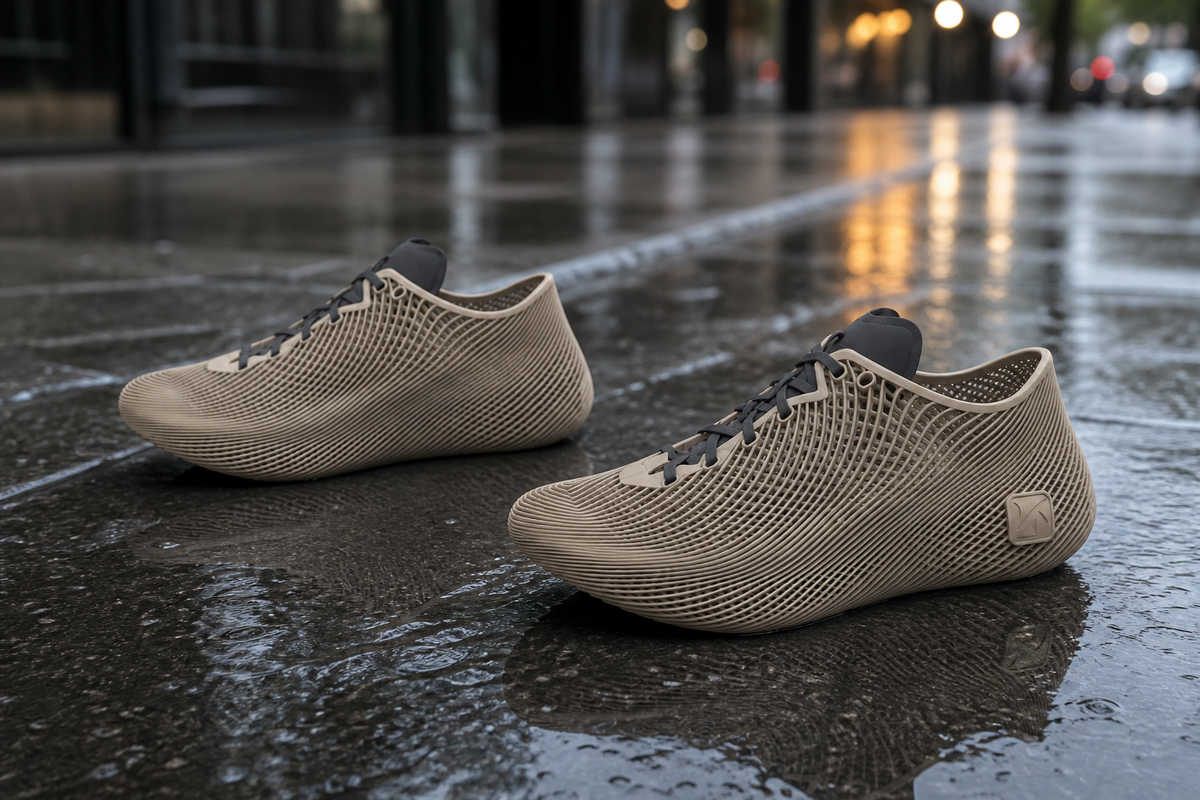
When you look at a printed shoe, you can literally see the zoning. Dense, tight cells clustered along the outer heel and the lateral forefoot are the signature of a lateral-support design. Uniform, identical cells everywhere suggest the lattice is decorative or tuned for cushioning only. Look for asymmetry between the inside and outside edges — asymmetry is the point.
Printed zonal support versus traditional stability builds

To keep the trade-offs visible, here is the same problem — "hold the outer edge of the foot" — solved four ways:
| Approach | How it works | Where the structure lives | Lateral-edge effect | Typical trade-off |
|---|---|---|---|---|
| Medial post (dual-density foam) | Firmer foam on the inner midsole slows arch collapse | Medial (inner) side | Minimal — nothing added on the outside | Adds stiffness and weight; ignores inversion |
| Guide-rail / frame systems | A firmer frame steers the foot rather than blocking it | Heel and inner side | Moderate, indirect | Can feel intrusive; complexity adds weight |
| Stiff heel counter + flared outsole | Rigid heel cup and widened base stop heel roll | Heel and ground contact | Strong at the heel, weak at the forefoot | Rigidity and weight; no midfoot/forefoot edge help |
| Printed zonal lattice | Cell density tuned per region — dense laterally, open centrally | Entire midsole, edge-specific | Direct and tunable from heel to forefoot | Requires printed construction; design-dependent quality |
The honest summary: traditional builds add structure in strips — heel, inner edge, outer heel — and ask the buyer to accept weight and stiffness where they may not need it. A zoned lattice can in principle put firmness exactly on the loaded edge and nowhere else. Whether any given printed shoe actually does this well depends on the density map, which is why the hand tests in the next section matter regardless of what you buy.
Who feels the wobble most

The wobble is not one audience's problem, but the priority order is fairly consistent:
Runners and court players with a sprain history
If you have rolled an ankle once — especially if you have done it more than once — your peroneal muscles and ligaments are the weak link, and up to 40% of first-time lateral sprains lead to chronic instability (Hertel & Corbett, 2019). For this group, shoe stability is a genuine safety feature, and the outer-edge structure matters more than any cushioning spec. Courts, trails, and any surface with unpredictable foot strikes amplify the requirement.
Trail hikers and loaded walkers
A loaded pack raises your center of mass and your wobble risk with it. On cambered or rocky ground the foot lands at angles foam shoes are not designed for, and a flared, firm outer edge is what keeps a misstep from becoming a roll.
Runners in tall, soft daily trainers
If your complaint is that an otherwise comfortable shoe feels nervous in turns or on edges, the fix is often geometry rather than more ankle work: lower stack, wider platform, or a firmer lateral edge — the reasons tall stacks wobble were covered above.
Everyday walkers on cambered streets
City streets slope toward the curb, which tilts the ankle outward for hours a day. For this group the wobble is less a dramatic roll than a constant low-grade instability, and people notice the difference most in shoes with a genuinely flat, wide, firm outer edge.
How to test a shoe for lateral stability before you buy
You do not need a gait lab to separate a stable shoe from a wobbly one. Three tests take about two minutes in any store:
The counter-pressure test. Press your thumb hard into the lateral side of the midsole, just behind the fifth toe and again at the outer heel. In a laterally stable shoe, the outer edge resists noticeably more than the center of the sole — you should feel a firm "shelf" under the outside of the foot. If the whole side squashes as easily as the middle, there is no lateral structure.
The platform test. Set the shoe on a flat table and press down on the outer edge of the heel. Watch the sole: a shoe with good lateral support tilts very little because the outsole flares out and the midsole holds. A shoe that visibly rolls is telling you what a cut will feel like.
The heel-hold test. Grip the heel counter between thumb and fingers and squeeze. Rigid is not automatically better — but a counter that folds flat offers your calcaneus nothing when the ground tilts.
Do the same three tests on the shoe you currently run in, and you will understand your wobble in about five minutes. This is also the fastest way to judge a 3D-printed shoe: a printed midsole with genuinely dense lateral zones will pass the counter-pressure test just like a well-built traditional shoe — and unlike many foam shoes, it will also be firm on the outside edge and soft in the middle, which is the combination foam builds struggle to deliver.
What to look for when you shop
If your shopping list is "lateral support" specifically, here is how we would weigh the options. The recommendations below are mechanism-based — match the shoe to the direction your foot actually moves — and every one of them should be checked with the three tests above before you commit.
A 3D-printed shoe with visible zonal density — e.g., the AeroDash, our own line at Arkky. Who it is for: people whose primary complaint is the outer edge — wobble on cuts, rolls on trails, that sinking feeling on the lateral side — and who also value light weight and breathability. Why it is on this list: the midsole is printed as one continuous part, so lateral-edge firmness does not have to be traded against midfoot softness, and there is no glue or second material to fail over time; the open lattice also drains and breathes in a way foam cannot. Reasons to hesitate: printed shoes are a young category, quality varies sharply between brands, and price — the AeroDash starts around $199 — is higher than entry-level foam. That is exactly why the hand tests matter: on a printed shoe they tell you instantly whether the density map is real or decorative. (If you want to compare current models yourself, browse the full current line of stability footwear and repeat the three tests.)
A lab-tested dual-density stability shoe, if your arch genuinely collapses. Who it is for: clear overpronation — wet-footprint tests show a near-flat arch — with knee or arch symptoms. Why: this category has decades of refinement behind it, and independent lab testing now measures torsional rigidity, midsole width, and posting geometry rather than trusting marketing claims; RunRepeat's overpronation guide is a good evidence-first starting point (RunRepeat). Reasons to hesitate: if your problem is inversion rather than pronation, the medial post is solving the wrong direction — do the thumb test on the outer edge before buying.
A neutral shoe with a stiff lateral sidewall or lateral posting, recommended by clinicians. Who it is for: people managing chronic lateral ankle instability, typically under the care of a physical therapist. Why: this is the category that clinical writers actually point lateral-instability patients toward today, precisely because it is small and under-marketed — Doctors of Running's guide lists current models with lateral sidewalls and posting (Doctors of Running). Reasons to hesitate: it is a short list, and availability changes quickly; also, no shoe replaces the rehabilitation work — balance training and peroneal strengthening — that is the actual treatment for CAI.
A low-to-mid stack, wide-platform daily trainer, if your wobble comes from tall soft shoes. Who it is for: runners who love cushioning but feel nervous at speed or on edges. Why: lowering the stack shortens the lever arm described earlier, and a wider platform with a firm lateral heel bevel restores edge confidence without sacrificing everyday comfort. Reasons to hesitate: if you are already in a stable, moderately stacked shoe and still roll, the issue is more likely structure than height — go back to the three tests.
One sentence that applies to all four: a shoe can remove risk factors for ankle rolls — edge firmness, platform width, heel hold, and a midsole that does not shear sideways under load — but it cannot remove the risk. If you have recurring sprains or true instability, the treatment is a physical therapist's program, and the shoe is part of it, not the whole of it.
Common questions about lateral support and printed shoes
Is overpronation the same as lateral instability?
No, and conflating them is the root of most confusing shoe advice. Overpronation is excessive inward roll (eversion) with arch collapse — a medial problem treated with medial posting. Lateral instability is excessive outward roll (inversion), stressing the lateral ligaments — an edge problem that needs edge structure. A shoe can address one, both, or neither.
Do 3D-printed shoes provide enough support?
It depends entirely on the density map, not on the fact of printing. A printed shoe with uniform decorative cells cushions like a soft foam and supports like one too. A printed shoe with deliberately dense lateral and arch zones behaves like a tuned stability shoe — which is why the counter-pressure test matters more on printed shoes, not less.
Are 3D-printed shoes good for running?
The published evidence is early but real: studies have measured that printed lattice midsoles change gait balance and heel rotation in running, walking, and jumping, and lattice cushioning has moved from concept to commercial running shoes over the past several years (Scientific Reports, 2025). What is not yet settled is durability across many hundreds of miles and how specific density maps perform for specific runners — judge each model on its own, and on your own feet.
Can the right shoe prevent ankle sprains?
It reduces the risk factors it can control — lateral-edge firmness, platform width, heel hold — which is meaningful for wobble-type incidents on level ground. It does not prevent the sprain that happens when you land badly on uneven terrain at speed; that is where strength, balance, and proprioception training carry the load. Shoes and rehab are partners, not substitutes.
The takeaway
The wobble effect has a mechanism, and mechanisms can be engineered. Traditional stability shoes were designed around the arch, which is why the outer edge — where roughly two million ankle sprains a year in the United States actually start — has been underserved for decades. Printed midsoles change the rules of that game because they tune stiffness geometrically, region by region, without glue, seams, or a second material. The science that lattice geometry changes lateral balance is now published, the manufacturing is commercial, and the remaining variable is the density map inside each shoe. So the next time a shoe feels unsteady on its outer edge, stop blaming your ankles. Ask the shoe where its structure lives. If the answer is "nowhere on the outside," the wobble is not a fitness problem — it is a design problem, and it has a solution.
This article is for general information and is not medical advice. If you have recurring ankle sprains or diagnosed instability, consult a physical therapist or physician.
Compartir:
Lattice vs. Mesh: Why Your Standard Mesh Sneakers are Actually Trapping Heat
360° Breathability: The Science of Airflow in 3D Footwear