

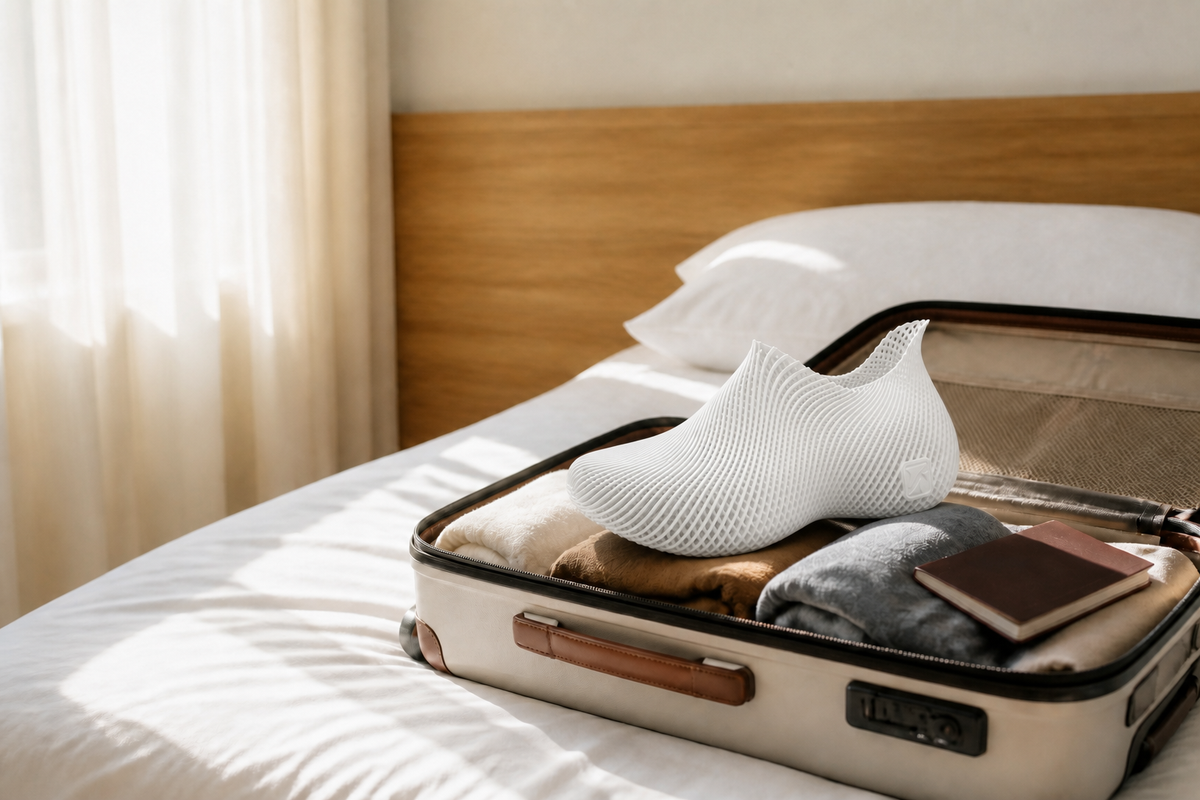

Somewhere over the Atlantic, around the fifth hour, most of us quietly kick our shoes off under the seat ahead. That is not a fashion decision; it is physiology. Legs that have been still for hours begin to hold fluid, and feet that fit perfectly at the gate feel noticeably different by the second meal service. Swelling of the feet and ankles during air travel is common enough that Mayo Clinic addresses it in plain language, and a PubMed-indexed study of long-haul flight documented significant fluid accumulation in the lower leg and thigh on exactly these flights. Meanwhile the industry keeps growing: IATA's outlook expects roughly 5.2 billion air passengers in 2026 — an enormous number of people trying to stay comfortable in shoes chosen for a departure lounge, not for the twelve-mile museum day waiting at the other end.
That gap between "comfortable in the airport" and "still comfortable at hour nine of sightseeing" is the real travel-shoe problem, and it is rarely solved by buying a softer shoe. This article is my attempt to work through it properly: what actually happens to feet on a travel day, how the three dominant shoe constructions each compromise differently, where 3D printing genuinely changes the trade-offs, where it does not, and how to test any travel shoe — including our own — before you trust it with a trip. I work for ARKKY, so this is not a neutral review; it is an engineering walkthrough with the numbers and the limits on the table, and it will end with a clear recommendation and an equally clear list of people who should not buy it.
What actually happens to your feet on a travel day
A travel day stacks three separate stresses on one pair of shoes, and most shoes are built to handle only one of them well.
The first stress is the flight itself. Prolonged sitting slows circulation in the lower legs, and fluid accumulates — the mechanism behind that familiar "my shoes feel tight by landing" sensation. Your feet also do not stay the same temperature in a pressurized, low-humidity cabin: hours in the same position, often in socks and enclosed shoes, raises the heat and moisture trapped against the skin, conditions that are associated with friction and blisters over a long day — a mechanism covered in a U.S. National Library of Medicine review of friction blisters of the feet.
The second stress is the ground. Sightseeing days are measured in many thousands of steps on hard pavement and cobblestone — far more than an ordinary office day produces, and on surfaces with none of the give of a gym floor. This is where cushioning, support, and a little room for the foot to spread matter most, and where a shoe that was merely "lightweight" starts to feel thin.
The third stress is the luggage. Travelers who pack in a single carry-on do not want to carry a second pair of shoes, which means the pair on their feet has to absorb rain, beach sand, and a hotel-sink rinse without becoming unwearable the next morning. Knit and wool shoes dry slowly because the materials hold water; foam shoes dry slowly because the foam does. If your only pair is still wet at breakfast, none of its other qualities matter.
Any shoe that solves all three at once is solving a systems problem, not a comfort problem — which is why it helps to look under the marketing before looking at the look.
Foam, knit, or lattice: how travel shoes are actually built

Nearly every "travel sneaker" on the market is one of two constructions, and both make the same quiet compromise.
A foam-soled shoe — EVA or expanded-TPU midsoles from running brands, walking brands, and most "cloud" or "energy" shoes — cushions through a block of material with one density. The block feels the same under the heel as under the arch, it compresses permanently over months of use, and when you wet it, the foam holds water like a sponge. Brands partly solve the heat problem with mesh uppers, but the midsole itself is a sealed, insulating slab.
A knit or wool shoe — the merino "travel sneaker" category — solves weight and packability by removing structure. The upper is a sock, and the midsole is usually a thin foam unit. These shoes are genuinely light and genuinely packable, but thin foam bottoms out on a long walking day, and the absorbent upper is the opposite of quick-drying in practice: wool and knit hold several times their weight in water and take a full night to dry after a rinse.
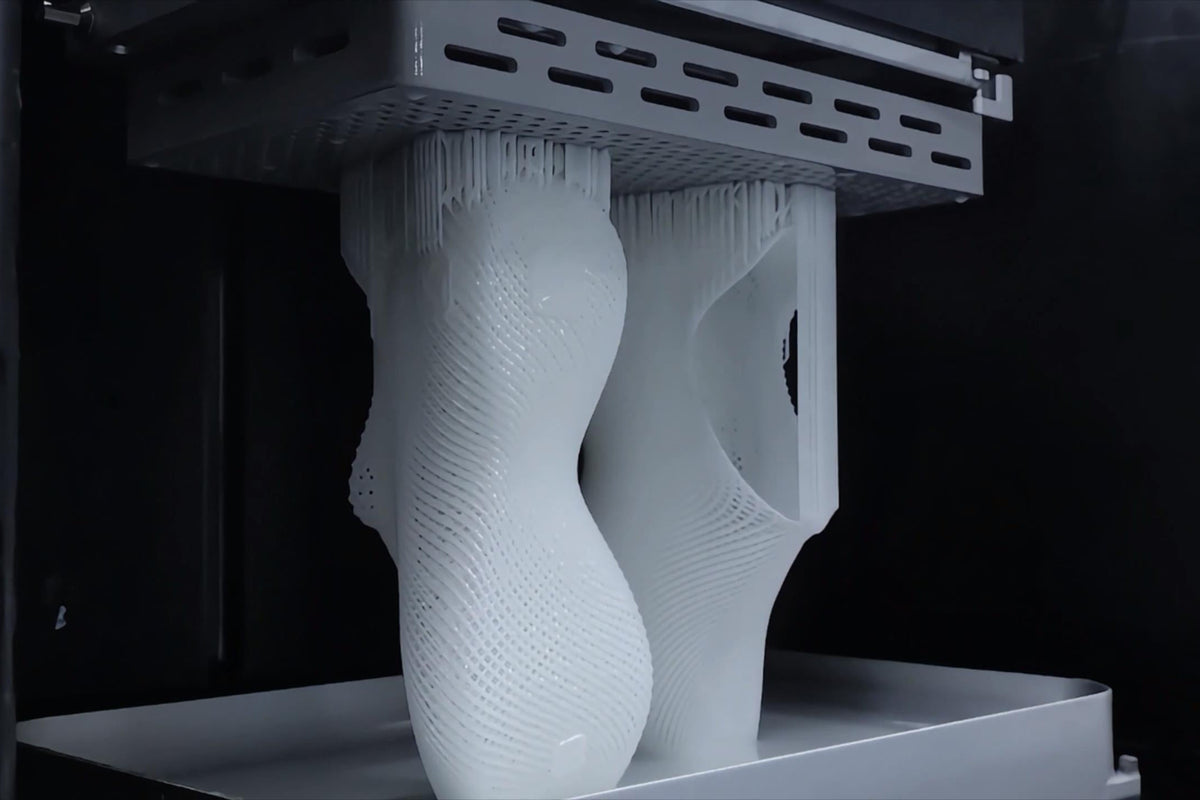
A 3D-printed lattice shoe is the third construction, and it works differently because it is not molded. The midsole is an open cellular structure printed in one piece from a single material, so cushioning comes from geometry rather than from a block of foam. Density can change across the shoe — firmer where the arch needs support, softer where the heel lands — within a single continuous piece, because each region is simply printed with different cell shapes. ARKKY's AeroDash is a working example: a $199 shoe printed from a single 53% bio-based TPU, no glue and no stitching anywhere, with drainage channels designed into the sole rather than relying on a "breathable" fabric to do the work — as described on the AeroDash product page.
The comparison below keeps to what each construction can and cannot do, without leaning on adjectives.
| Attribute | Foam sneaker | Knit / wool "travel shoe" | 3D-printed lattice (ARKKY AeroDash) |
|---|---|---|---|
| Cushioning source | One block of foam, single density | Thin foam unit under a sock upper | Open-cell lattice; density tuned by region and by size |
| Breathability | Mesh upper; foam midsole stays sealed | Fabric porosity; holds heat when damp | Structure is open from sole to upper; airflow through the shoe |
| After a rinse or rain | Foam holds water; dries overnight or longer | Absorbent upper; often still damp in the morning | Single non-absorbent material; drainage channels shed water |
| Long-wear failure | Foam compresses and "bottoms out" over months | Foam compresses; knit pills and stretches | No foam to compress, no glue to fail; structure wears as a unit |
| Glue / delamination | Sole bonded with adhesive; a known failure point | Adhesive + stitching | Printed in one piece; no adhesive joints |
| End of life | Multi-material; hard to recycle | Multi-material; hard to recycle | Single-material TPU; recyclable in principle (53% bio-based) |
| Fit logic | Standard sizes from a fixed last | Sizes + stretch of the knit | Standard sizes (EU 35–48); lattice map tuned per size, not per foot |
| Typical price | $80–180 | $100–160 | $199 |
Two notes before anyone reads this table as a verdict. First, the AeroDash column reflects ARKKY's published specifications and claims — the 53% bio-based TPU, the drainage-channel design, and the size range are from the product page, not from independent testing. Second, "no per-foot scanning" is deliberate: these are standard-size shoes with a lattice design tuned across the size range, which is a different and more honest claim than custom-made orthotics.
Comfort at altitude: swelling, moisture, and what structure can do

The two in-flight problems — feet that swell and feet that overheat — are structural problems, and structure is exactly what printed geometry can address.
Start with heat. Research on shoe microclimates found that open, more breathable upper constructions measurably reduce temperature and humidity inside the shoe compared with closed ones (a 2024 study in the Journal of Thermal Biology measured exactly this difference). A knit upper is porous, but the foam slab under it still traps heat from below. A lattice shoe keeps the same open structure under the foot, which is why ARKKY describes AeroDash as breathable from every angle — the airflow path is not limited to the upper. On a ten-hour flight, that difference is the difference between dry socks and damp ones.
Second, swelling. No off-the-shelf shoe can adapt its volume to a swollen foot, and anyone who claims otherwise is overselling. What a shoe can do is avoid making the problem worse: no rigid counter digging into a foot that has expanded, room in the toe box, and a closure that does not need to be cranked down to hold the shoe on. The clinical evidence that printed structures change how a foot is supported comes mostly from custom orthoses, where a 2025 systematic review of 3D-printed orthoses found printed devices at least matching conventionally made ones on comfort and fit — useful context, but a reminder that geometry matters. A shoe built from standard sizes with geometry tuned for the range sits honestly between a mass-market last and a $600 custom scan, which is where most travelers actually live.
The same geometry that manages heat also manages the third-hour foot: an open structure has give, and give matters more than softness when your feet are doing something unusual at altitude.
Packability without the compromises
The reason travelers love knit shoes is that they squash flat. The reason they eventually stop loving them is that a squashed sock with a thin sole is what they are walking on all week.
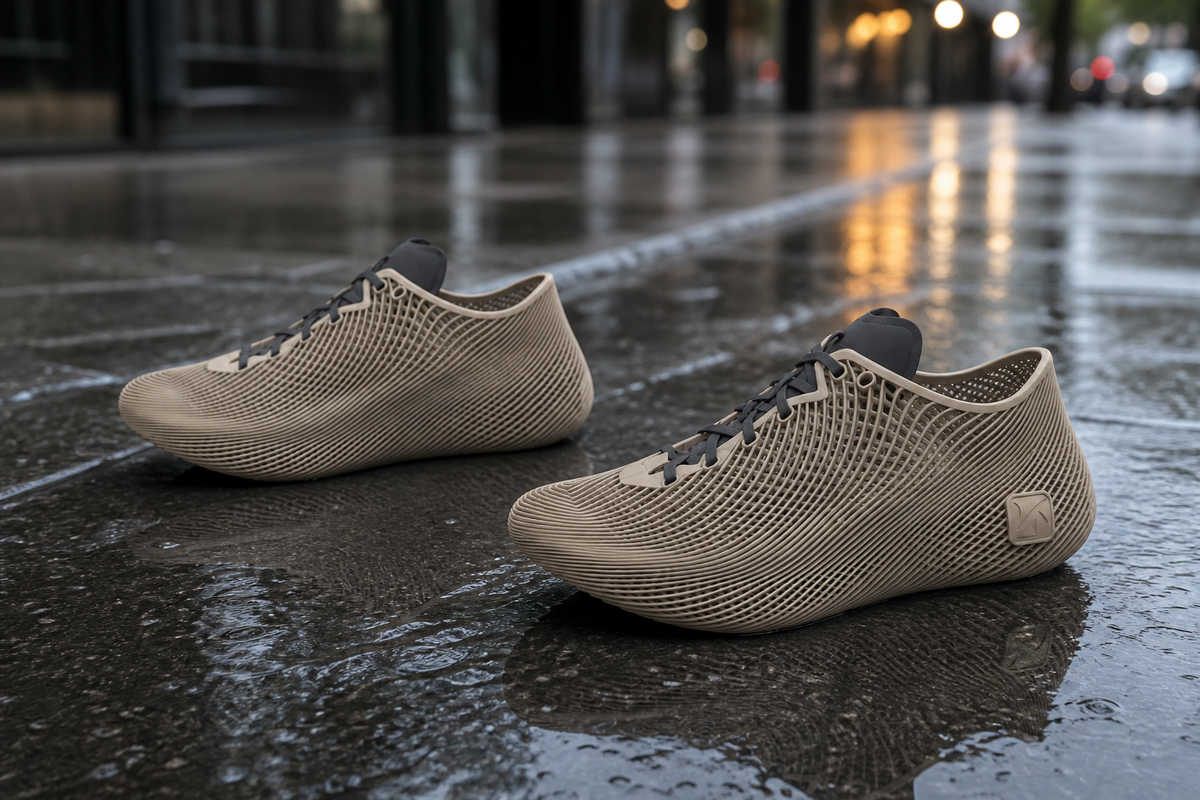
A printed shoe takes a different route to the same goal: you do not need to carry two pairs if the one pair handles the flight, the rain, and the rinse. That is the actual packability argument, and it depends less on how flat the shoe folds than on how fast it returns to service. After a rainy day or a beach walk, a single-material TPU shoe can be rinsed in a hotel sink, shaken, and left by the window; the non-absorbent material does not hold the water that fabric and foam would. ARKKY's product page describes drainage channels designed to shed water quickly, and customer reviews quoted there report shoes drying within minutes rather than overnight.
Worth being precise about one claim you will see elsewhere: "quick-dry" is doing a lot of work in travel-shoe marketing. A fabric shoe can be quick-drying relative to a boot and still be damp at breakfast. The material question is not how fast a surface dries, but whether the shoe holds water internally at all. Foam and fabric do; a solid polymer does not. That single property is what makes "rinse it in the sink" a realistic hotel routine instead of a gamble.

The honest limits of a young category
Before the recommendation, the part most articles skip: what a printed travel shoe is not, and where a conventional shoe still wins.
Price is the first limit. At $199, AeroDash sits above most foam and knit travel shoes, and the category has not yet benefited from decades of manufacturing scale. Choice is the second: you will not find printed versions of every silhouette — no printed hiking boot with a lugged outsole for serious trails, no printed carbon-plate racer, no wide-width system comparable to established lines. Third, the durability evidence is young: printed shoes have not accumulated the millions of wear-hours that foam shoes have, so quality claims rest on mechanism and early data rather than decades of field use. Fourth, the sizing model is standard sizes. If your feet are far outside the EU 35–48 range or you need medical-grade support, a printed lifestyle shoe is not the answer — that is what a podiatrist and a properly fitted orthopedic shoe are for. Delamination complaints in one-bag communities (r/onebag threads collect these stories) are a real reason travelers distrust glued shoes, but the fix is not "buy any printed shoe" — it is understanding which failure modes each construction eliminates and which it does not.
Where AeroDash fits — and where it doesn't

So who should actually buy this shoe? The answer, in plain terms: the traveler whose trip is cities, flights, and feet — the person who wants one pair that will not betray them on a walking-heavy trip and will be dry and wearable the morning after a rinse.
The reasons are the structural ones above, and they are worth stating with their evidence attached:
- Heat management on the flight. The microclimate research shows open structures reduce in-shoe temperature and humidity; the lattice keeps that openness under the foot, not just at the upper. This is a mechanism, not a slogan — and it is exactly the "breathable travel shoes" problem travelers search for.
- Overnight dry after a rinse. Single-material TPU does not hold water, and the drainage channels are printed into the sole. For one-bag travelers, "washable sneaker" stops being a marketing label and becomes a packing strategy.
- No glue, no delamination. The entire shoe is printed as one piece, which removes the failure mode that dominates complaints about travel shoes that fall apart on long trips.
- An honest fit story. Standard sizes with a lattice map tuned per size, clearly stated — no fake "custom orthotic" premium, which is refreshingly rare in a category full of overpromises.
- A sustainability story with substance. 53% bio-based TPU and single-material construction make the recyclability claim mechanically plausible rather than decorative, though — as with any brand — the actual take-back loop is worth asking about.
The people who should not buy it are equally specific: trail hikers needing technical outsoles, runners training for races who already own specialized shoes, anyone needing medical-grade foot support, and travelers who simply prefer a wider range of styles than a young category offers. For those cases, the foam or knit shoes this article has been honest about remain the right tool.
If you want to browse current options rather than take our word for it, the full range of lightweight travel shoes is on the ARKKY site, and the AeroDash product page lists the specifications cited here.
How to test a travel shoe before you commit
The honest way to evaluate any travel shoe — printed, foam, or knit — is to simulate the three stresses at home before you fly. This takes an afternoon and a weekend, and it will tell you more than any review:
Test it in the afternoon. Feet swell slightly through the day even on the ground. If the shoe fits comfortably at 6 p.m., it will fit better at 9 a.m. Try on and buy in the afternoon, in the socks you will actually fly in.
Walk a real distance in it. Five miles of pavement tells you more about a travel shoe than a store carpet does. Pay attention to where fatigue builds — heel, arch, ball of foot — and compare it with your usual walking shoe.
Wet it on purpose. Run it under a tap or step through a puddle, then time the dry. Fabric shoes that take twelve hours are not "quick-dry"; they are damp. A shoe that sheds water is a shoe you can pack without a plastic bag.
Pack it. Put it in your carry-on the way you would on the trip: if it has to share space with everything else, it should survive being wedged under a compression cube without losing shape.
Wear it for a full day before the trip. A shoe that is comfortable for an hour in a store is not the same as a shoe that is comfortable at hour nine. Your feet are the only test instrument that matters, which is why every brand worth buying from — including us — offers a return window rather than a confidence slogan.
Questions travelers ask about flying in 3D-printed shoes
Do feet really swell on long flights?
Yes, commonly. Sitting for hours slows circulation in the lower legs, and the PubMed-indexed long-haul study cited above documented significant fluid accumulation. Mayo Clinic notes the swelling is usually harmless but advises movement, hydration, and roomy shoes.
Are shoes without laces better for airport security?
Metal-free shoes will not set off the walk-through arch, which removes the usual reason to remove them. Printed shoes have no hardware at all — no eyelets, no shank, no metal shank plate — so they are as simple as slip-ons at security while keeping a proper laced fit in the air. In PreCheck lanes you keep shoes on anyway; the convenience is mostly about not fumbling with laces at the belt.
Can you wear 3D-printed shoes without socks?
You can, and it is one of the more comfortable ways to fly in them: there is no absorbent lining to hold sweat against the skin, and the open structure lets air move through. If you prefer socks, the same structure keeps the interior from turning into a damp pocket over ten hours.
Will rinsing the shoe at the hotel damage the lattice?
No. The material is a solid polymer printed into an open structure; rinsing removes surface dirt and the water drains out through the cells. The same property that makes the shoe quick-drying makes it low-maintenance — no fabric to stain, no lining to mildew. Just rinse, shake, and let it sit by a window.
Can lattice shoes be packed flat or squashed?
They do not fold like a knit slipper, and they should not need to. The point is that you carry one pair instead of two. The structure holds its shape under normal packing pressure, and the open cells compress slightly and return — which is the same resilience that cushions your heel on cobblestones.
Are 3D-printed shoes good for all-day city walking?
For city days — pavement, museums, long stretches of walking — the zoned lattice is designed to be firm where the arch needs support and softer under the heel, which is a more useful profile for hard surfaces than a uniformly soft slab. If you need high-mileage running or technical terrain, buy the appropriate specialized shoe instead.
A closing note
No single shoe is right for every traveler, and this article is not arguing that printed shoes have replaced the alternatives. It is arguing something narrower: that the three stresses of a travel day — swollen feet at altitude, many thousands of steps on hard ground, and a single pair that has to survive a rinse by morning — are structural problems, and that structural problems are exactly what a structure-based shoe addresses. The foam shoe and the knit shoe remain excellent at what they were built for. For the traveler who wants one pair to do all three jobs, the lattice changes the math in a way that is worth testing with your own feet — ideally in the afternoon, on a five-mile walk, in the rain.
Sources and further reading
- Mayo Clinic, "Foot swelling during air travel: A concern?" — expert-answer FAQ (updated 2023).
- "Formation of edema and fluid shifts during a long-haul flight" — peer-reviewed study, indexed on PubMed.
- IATA, Global Outlook for Air Transport, December 2025 (about 5.2 billion passengers expected in 2026).
- "Influence of shoe upper structure on shoe microclimate and human body temperature," Journal of Thermal Biology, 2024.
- "The current state of 3D-printed orthoses clinical outcomes: a systematic review," 2025.
- "Friction blisters of the feet," U.S. National Library of Medicine review.
- ARKKY AeroDash product page (manufacturer specifications cited in this article).
- r/onebag community discussion on packable shoes.
يشارك:
الرحّالة العصري: معدات الحياة الرقمية
Why Mass-Market Fashion Is Starting to Take 3D-Printed Shoes Seriously